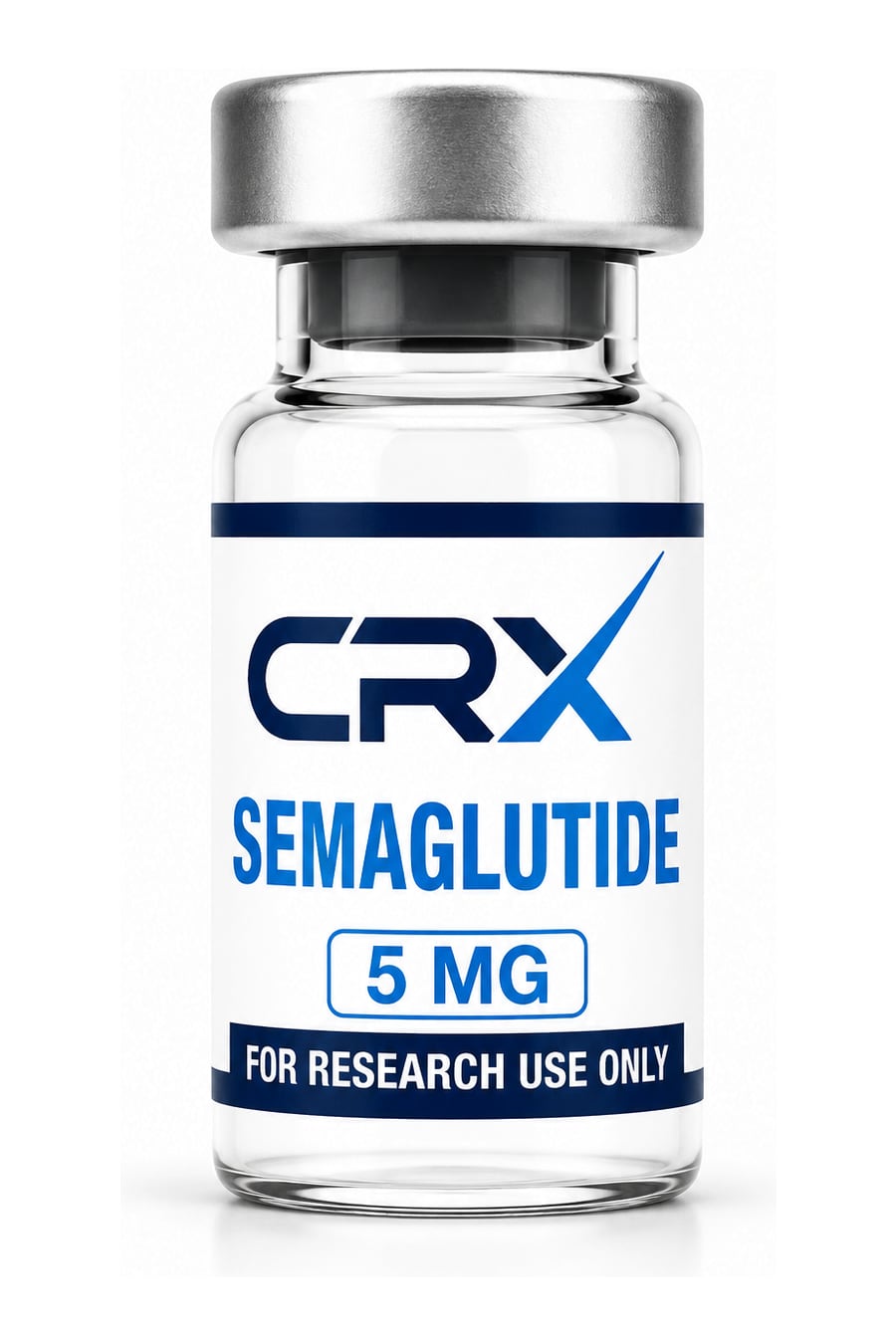
Semaglutide
- Fat loss & metabolism
- Focus & brain health
The GLP-1 benchmark every newer weight-loss compound is measured against — 14.9% of body weight over 68 weeks, against 2.4% on placebo.
Read the published research →What Semaglutide does
Semaglutide is the GLP-1 receptor agonist the rest of the class gets compared to, and it carries by far the largest trial base here. In STEP 1, adults with obesity and no diabetes lost 14.9% of body weight over 68 weeks against 2.4% on placebo, and half of them lost at least 15% against 4.9% on placebo. What followed went well past the scale: across 17,604 people in SELECT, cardiovascular death, heart attack or stroke fell to 6.5% from 8.0% on placebo over a mean 39.8 months; major kidney disease events in FLOW fell to 331 patients from 410 on placebo, stopping that trial early; and in biopsy-confirmed fatty liver disease, steatohepatitis resolved in 62.9% against 34.3% on placebo. It is not the strongest single option for weight — tirzepatide reached −20.2% against semaglutide's −13.7% in the one head-to-head trial — and two phase 3 trials in Alzheimer's disease found no slowing of progression. Gastrointestinal effects are the common complaint (risk ratio 1.49 against placebo), 16.6% stopped treatment for adverse events against 8.2% on placebo in SELECT, and diabetic retinopathy complications were more frequent than placebo in the SUSTAIN-6 diabetes trial.
- Sustained weight loss with the longest track record
- Appetite suppression and food-noise reduction
- Blood-sugar control in type 2 diabetes
- Cardiovascular risk alongside weight change
- Liver fat and fatty liver disease
- Cravings, including alcohol intake
Common areas of interest, not measured results. The findings below are the published data.
In a 68-week double-blind trial in 1961 adults with obesity or overweight without diabetes (STEP 1), mean body weight changed by −14.9% in the semaglutide 2.4 mg group versus −2.4% with placebo (−15.3 kg versus −2.6 kg), and 50.5% versus 4.9% of participants lost at least 15% of baseline weight.7
In an event-driven trial in 17,604 adults aged 45 or older with established cardiovascular disease and BMI 27 or greater but no diabetes (SELECT), the composite of cardiovascular death, non-fatal myocardial infarction or non-fatal stroke occurred in 6.5% of the semaglutide 2.4 mg group versus 8.0% on placebo over a mean 39.8 months (hazard ratio 0.80, 95% CI 0.72–0.90).8
In the week-72 interim analysis of a phase 3 trial in 800 patients with biopsy-defined metabolic dysfunction-associated steatohepatitis and fibrosis stage 2 or 3 (ESSENCE), resolution of steatohepatitis without worsening fibrosis occurred in 62.9% of the semaglutide 2.4 mg group versus 34.3% on placebo, and fibrosis improved without worsening steatohepatitis in 36.8% versus 22.4%.9
For laboratory research use only. Not a drug, food, or cosmetic. Not for human or veterinary use, ingestion, or any form of consumption. Sold exclusively to qualified researchers.