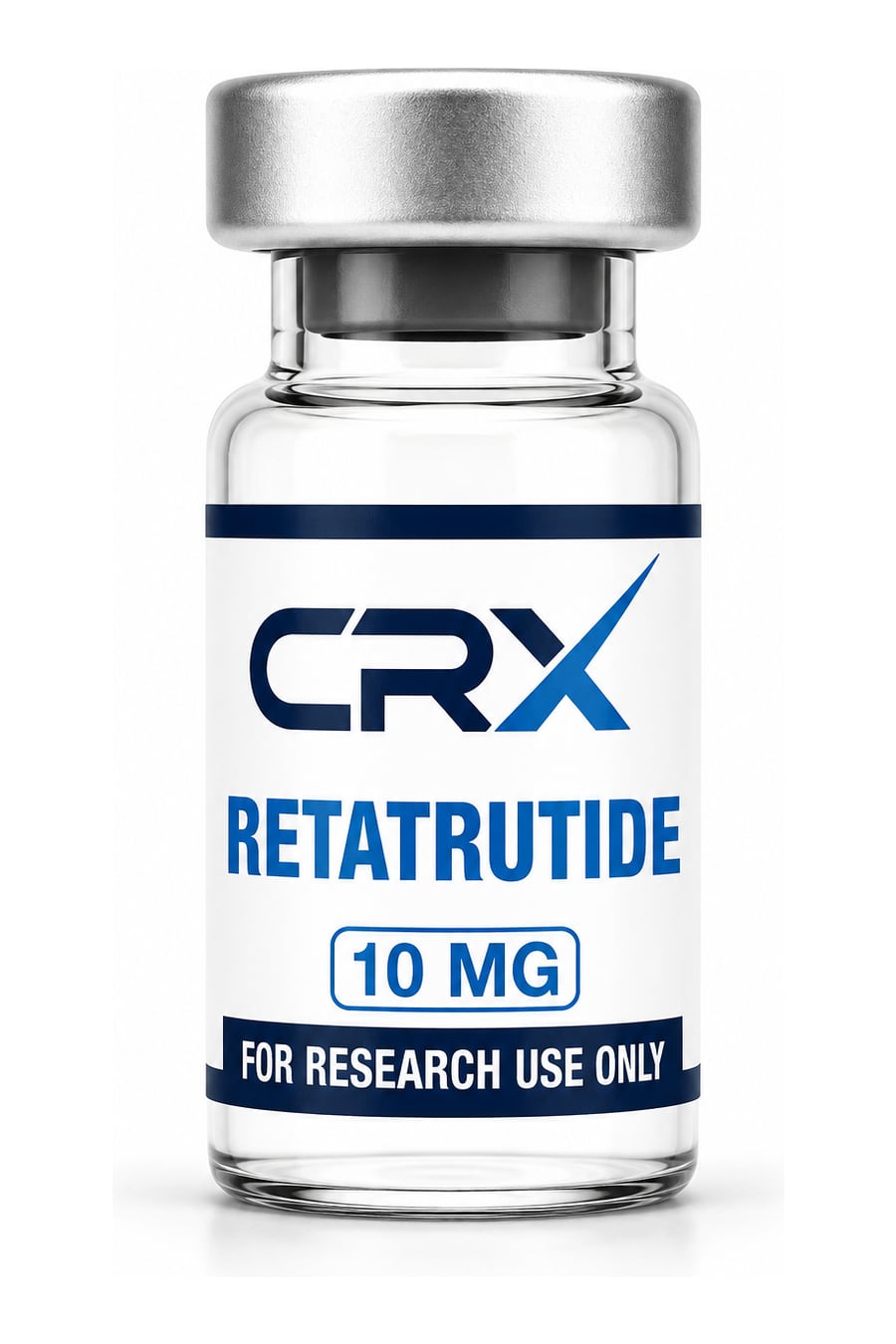
Retatrutide
- Fat loss & metabolism
- Inflammation & immunity
- Focus & brain health
The strongest weight-loss numbers in the catalog — 24.2% of body weight over 48 weeks, against 2.1% on placebo.
Read the published research →View COAs3 reports
| Tested sample | Task number | Analysis date | Measured results | Report |
|---|---|---|---|---|
| 15 mg | 137040 | Apr 29, 2026 | Retatrutide: 16.53 mg · Purity: 99.829% | |
| 30 mg | 171219 | Jun 23, 2026 | Retatrutide: 34.92 mg · Purity: 99.472% | |
| 60 mg | 171267 | Jun 23, 2026 | Retatrutide: 64.85 mg · Purity: 99.753% |
What Retatrutide does
Retatrutide hits three receptors at once — GLP-1, GIP and glucagon — where the semaglutide class hits one, and the third is what separates it. In a 48-week phase 2 trial in 338 adults with obesity, the highest-dose group lost 24.2% of body weight against 2.1% on placebo, and 83% of them lost at least 15%, against 2% on placebo. The glucagon limb appears to raise energy expenditure rather than only suppressing appetite, which is the mechanism the other two account for. Liver fat fell 42.9% to 82.4% across dose groups in adults with fatty liver disease, against a 0.3% rise on placebo. Gastrointestinal effects are the common complaint — 35% of treated participants against 13% on placebo — along with a dose-dependent rise in heart rate that peaked at 24 weeks.
- Weight loss beyond what GLP-1-only compounds reach
- Appetite suppression and food-noise reduction
- Liver fat and metabolic-syndrome markers
- Energy expenditure rather than appetite alone
- Blood-sugar control alongside weight change
- Body recomposition, tracked by fat mass against lean mass
Common areas of interest, not measured results. The findings below are the published data.
In a 48-week phase 2 randomised placebo-controlled trial in adults with obesity, least-squares mean body-weight change at week 48 was −8.7% (1 mg), −17.1% (4 mg), −22.8% (8 mg) and −24.2% (12 mg) once-weekly, versus −2.1% with placebo.3
In the same trial, the proportion reaching at least 15% body-weight reduction at week 48 was 60% (4 mg), 75% (8 mg) and 83% (12 mg) versus 2% with placebo; at least 10% was reached by 75%, 91% and 93% versus 9% with placebo.3
In a phase 2 placebo- and dulaglutide-controlled trial in adults with type 2 diabetes, HbA1c change at 24 weeks was −2.02% in the 12 mg group versus −0.01% with placebo and −1.41% with dulaglutide 1.5 mg; body-weight reduction at 36 weeks reached 16.94% versus 3.00% and 2.02% respectively.5
For laboratory research use only. Not a drug, food, or cosmetic. Not for human or veterinary use, ingestion, or any form of consumption. Sold exclusively to qualified researchers.