BPC-157 + TB-500
- Recovery & repair
- Skin & hair
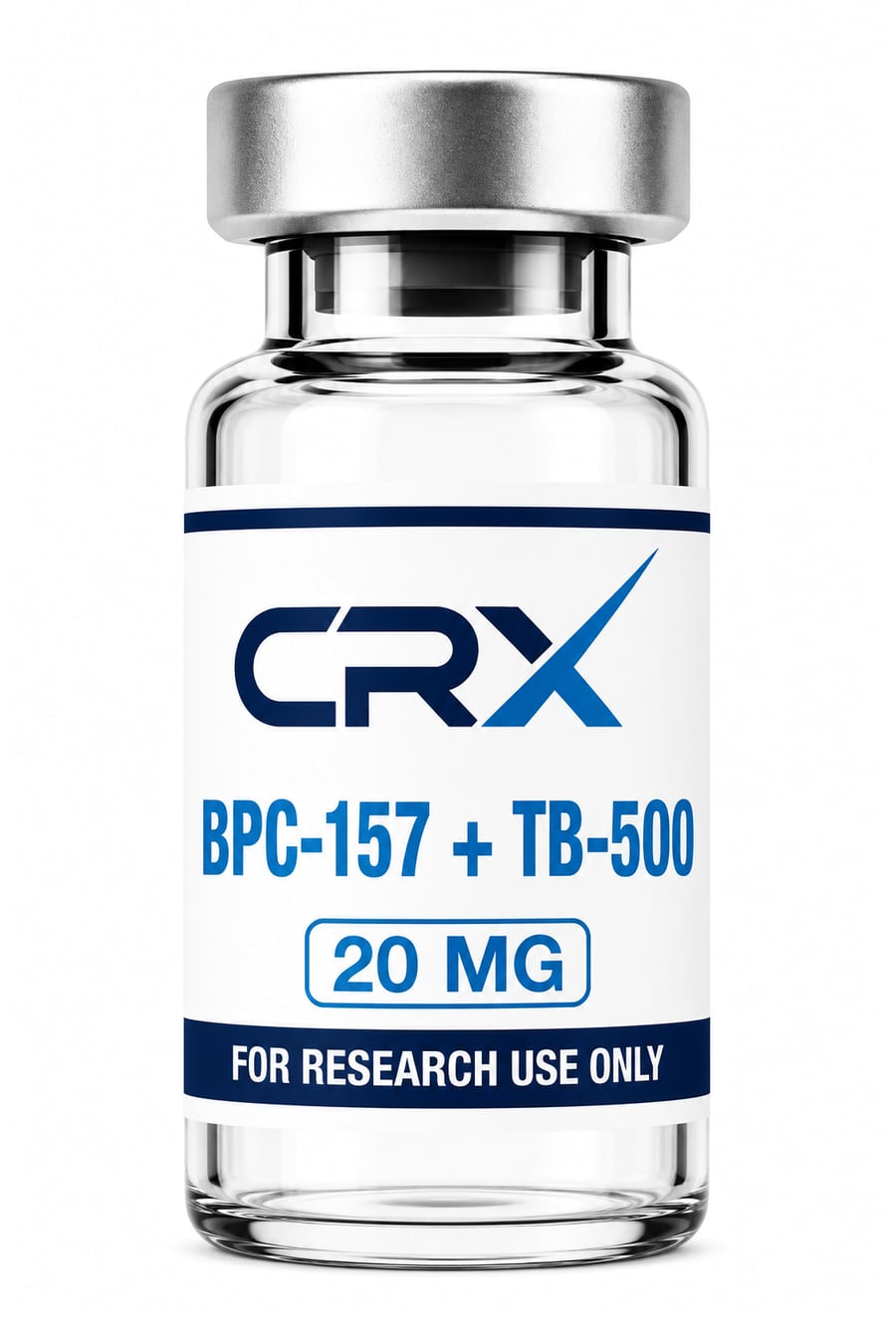
The repair stack — two peptides in one vial, one working on blood supply into damaged tissue and the other on the actin machinery of wound and soft-tissue healing.
Read the published research →View COAs1 report
| Tested sample | Task number | Analysis date | Measured results | Report |
|---|---|---|---|---|
| 10 mg total | 137065 | Apr 30, 2026 | BPC-157: 5.73 mg · TB-500 (TB4): 5.36 mg |
What BPC-157 + TB-500 does
BPC-157 and TB-500 cover two different halves of repair, and the literature treats them as the separate molecules they are. Full-length thymosin beta-4, the parent peptide TB-500 is a fragment of, sped reepithelialisation in dermal wounds by 42% over saline controls at four days and by as much as 61% at seven days, and packed into a cut knee ligament it produced better-organised collagen and better mechanics at four weeks than sealant-only controls. BPC-157 supplies the vascular half: it raises VEGFR2 in cultured human endothelial cells without changing VEGF-A, and blood flow returned faster to ischaemic limbs with more vessels in the muscle. Most of that work is in rats, and nearly all of the wound evidence used the full-length parent rather than the acetylated fragment actually sold as TB-500 — the two share an actin-binding motif, not a molecule. In the one human report giving both to the same patients, 3 of 4 reported improvement against 11 of 12 on BPC-157 alone, and intravenous full-length thymosin beta-4 in healthy volunteers produced infrequent adverse events, all mild or moderate.
- Tendon, ligament and joint recovery
- Wound and skin healing
- Post-injury and post-surgical repair
- Blood supply to injured tissue
- Soft-tissue flexibility after strain
- Two repair pathways rather than one
Common areas of interest, not measured results. The findings below are the published data.
In a small 56-day phase 2 randomised, double-masked, vehicle-controlled trial in nine patients with severe dry eye, full-length thymosin beta-4 eye drops (RGN-259, 0.1%) reduced ocular discomfort 35.1% more (P = 0.0141) and total corneal fluorescein staining 59.1% more (P = 0.0108) than vehicle at day 56, comparing 12 treated with 6 control eyes.17
In the only published human report giving both constituents to the same patients, an uncontrolled retrospective chart review of 17 adults with mixed-aetiology knee pain at a single private clinic, 16 of whom were reached by telephone, 3 of the 4 patients given intra-articular BPC-157 with thymosin beta-4 reported significant improvement and 1 reported none, against 11 of 12 after BPC-157 alone; there was no control group, no randomisation and no validated outcome instrument, and the authors used a self-reported pain rating collected from most patients 6 to 12 months after injection.3
In an uncontrolled single-arm pilot study of 12 women with moderate-to-severe interstitial cystitis refractory to pentosan polysulfate, all 12 scored 5 of 5 on the Global Response Assessment after a single procedure delivering BPC-157 around the inflamed bladder wall: 10 of 12 reported complete symptom resolution, 2 of 12 roughly 20% of symptoms persisting. There was no placebo arm, no blinding and no independent replication.18
For laboratory research use only. Not a drug, food, or cosmetic. Not for human or veterinary use, ingestion, or any form of consumption. Sold exclusively to qualified researchers.