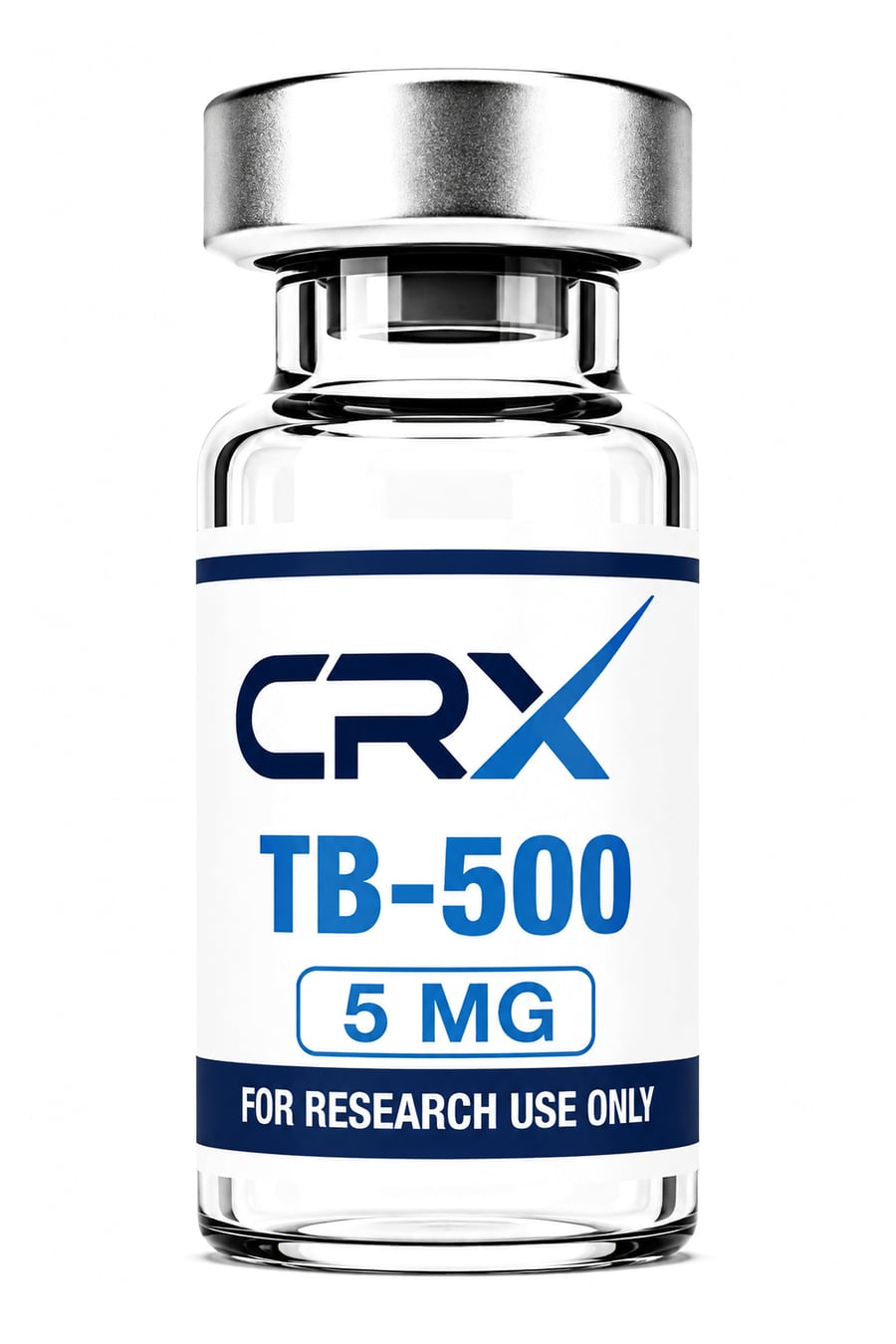
TB-500
- Recovery & repair
- Skin & hair
- Focus & brain health
The tissue-repair peptide built on thymosin beta 4 — studied for wound and skin healing, fracture and soft-tissue recovery, and inflammation at an injury site.
Read the published research →View COAs1 report
| Tested sample | Task number | Analysis date | Measured results | Report |
|---|---|---|---|---|
| 10 mg | 171251 | Jun 22, 2026 | TB-500 (TB-4): 11.66 mg · Purity: 99.066% |
What TB-500 does
TB-500 is built on the actin-binding region of thymosin beta 4, and one fact about the product is worth stating plainly: what is sold under this name is a short acetylated fragment, while the published pharmacology is on the full-length 43-residue peptide. That parent peptide's repair record is specific — full-thickness skin wounds re-epithelialised 42% faster than saline controls at four days and up to 61% faster at seven; fracture calluses came out with 41% greater peak force to failure and about 25% greater stiffness than saline; and after spinal cord compression, myelin basic protein was 57.8% higher and the activated-microglia marker ED1 36.9% lower than in controls, alongside better locomotor recovery. Its biochemistry is well characterised: it binds monomeric actin one to one and holds the bulk of the unpolymerised actin in resting human platelets. Most of the repair work is in rats and mice, and the human trials all used the full-length peptide — in 96 patients treated after a heart attack, infarct area at 90 days matched placebo across the whole group and separated only in the 43 treated within eight hours. Tolerability across those trials was mild to moderate with no serious adverse events, though mass spectrometry of internet-sold TB500 preparations found their contents inconsistent with how they were sold, and thymosin beta 4 is overexpressed in a range of cancers, where silencing it suppressed tumour growth in mice.
- Soft-tissue, tendon and muscle repair
- Wound healing and skin regeneration
- Range of motion after an injury
- Inflammation at an injury site
- Recovery time after hard training
Common areas of interest, not measured results. The findings below are the published data.
In a randomised, double-blind, placebo-controlled trial in 96 patients with ST-segment elevation myocardial infarction treated by primary PCI, infarct area at 90 days did not differ significantly between recombinant human thymosin β4 and placebo across the full cohort; the difference reached significance only in the 43 patients whose first dose came within 8 hours of PCI.11
In a single-centre phase 2 trial, 72 adults with moderate-to-severe dry eye were randomised 1:1 to 0.1% thymosin β4 eye drops or placebo for 28 days. Neither primary endpoint (ocular discomfort or inferior corneal staining at day 29) separated from placebo; discomfort during the day-28 controlled adverse environment challenge fell 27% relative to placebo (P=0.0244) and central and superior corneal staining improved (P=0.0075 and P=0.0210).13
In a 56-day multicentre phase 2 trial in 9 patients with severe dry eye, including graft-versus-host-associated disease, the 0.1% thymosin β4 group (12 eyes) showed a 35.1% reduction in ocular discomfort (P=0.0141) and a 59.1% reduction in total corneal fluorescein staining (P=0.0108) versus vehicle control (6 eyes) at day 56, 28 days after dosing stopped.14
For laboratory research use only. Not a drug, food, or cosmetic. Not for human or veterinary use, ingestion, or any form of consumption. Sold exclusively to qualified researchers.