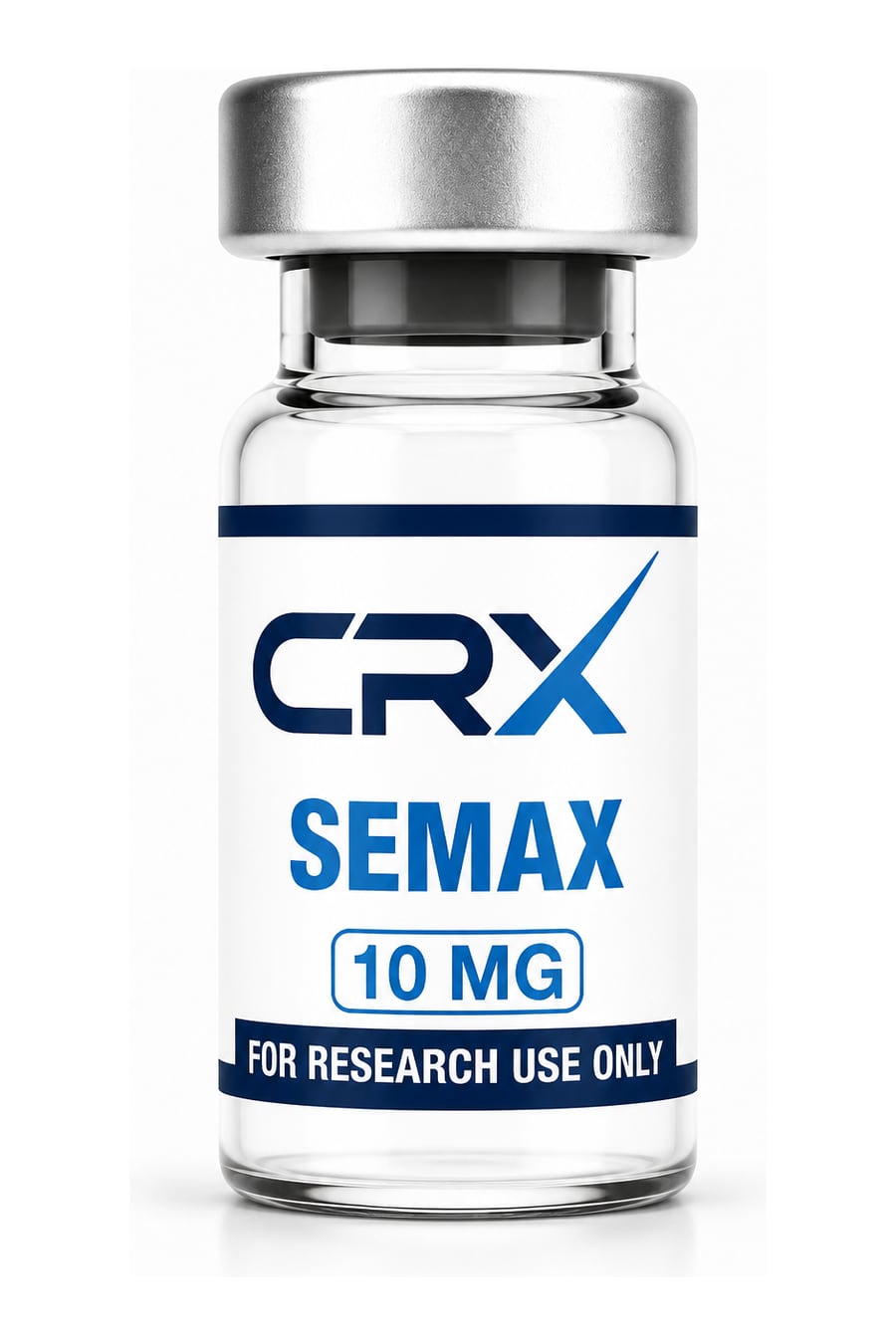
Semax
- Focus & brain health
- Inflammation & immunity
The brain peptide — studied for focus and mental stamina, recovery after a stroke, and raising BDNF.
Read the published research →View COAs1 report
| Tested sample | Task number | Analysis date | Measured results | Report |
|---|---|---|---|---|
| 10 mg | 171241 | Jun 22, 2026 | Semax: 10.45 mg · Purity: 99.336% |
What Semax does
Semax is a seven-residue peptide built from a fragment of ACTH with a Pro-Gly-Pro tail added to slow its breakdown; unlike ACTH itself, it does not act as a stress hormone. Its most reproduced effect is on neurotrophins — intranasal Semax raised BDNF protein in the basal forebrain within three hours while leaving the cerebellum unchanged, and after experimental stroke it shifted transcription of BDNF, NGF and their Trk receptors in the injured cortex. RNA sequencing in the same stroke model found 394 genes shifted more than 1.5-fold against saline at 24 hours, inflammatory genes suppressed and neurotransmission genes switched on — the opposite direction to what the injury did on its own; most of that work is in rats. In people it is prescribed in Russia after ischaemic stroke, and a placebo-controlled imaging session in 24 healthy volunteers found a larger rostral medial frontal component of the default mode network within twenty minutes of a single intranasal dose. One interaction is worth knowing: given before amphetamine in rodents, Semax dramatically amplified that drug's effect on striatal dopamine and on locomotor activity.
- Focus, mental clarity and cognitive stamina
- Recovery after a stroke or brain injury
- BDNF and neurotrophic support
- Stress resilience and mood
- Attention and drive under fatigue
Common areas of interest, not measured results. The findings below are the published data.
In 110 adults after ischaemic stroke, split into early (89 +/- 9 days) and late (214 +/- 22 days) rehabilitation groups and each into semax and no-semax subgroups, semax raised plasma BDNF, which remained elevated throughout, and both accelerated improvement and improved final Barthel index. There was no placebo arm and no blinding is described; the authors credit early rehabilitation together with semax rather than semax alone.14
In 30 patients treated during the acute period of hemispheric ischaemic stroke, compared with a control group of 80 patients whose strokes were analogous in severity and lesion location and who received conventional therapy, adding semax to combined intensive therapy was reported to have some influence on the rate of restoration of damaged neurological functions, increasing the regression of general cerebral and focal - especially motor - disorders as assessed by clinical rating scales, EEG monitoring with mapping and somatosensory evoked potentials; the study was a non-randomised controlled clinical trial.15
In 24 healthy volunteers (mean age 43.9 +/- 9.5 years) scanned by resting-state fMRI before and 5 and 20 minutes after intranasal dosing, the 14 given semax showed a greater volume of the rostral medial frontal subcomponent of the default mode network than the 10 given placebo. The session measured network topography only; no cognitive, behavioural or clinical outcome was recorded.16
For laboratory research use only. Not a drug, food, or cosmetic. Not for human or veterinary use, ingestion, or any form of consumption. Sold exclusively to qualified researchers.