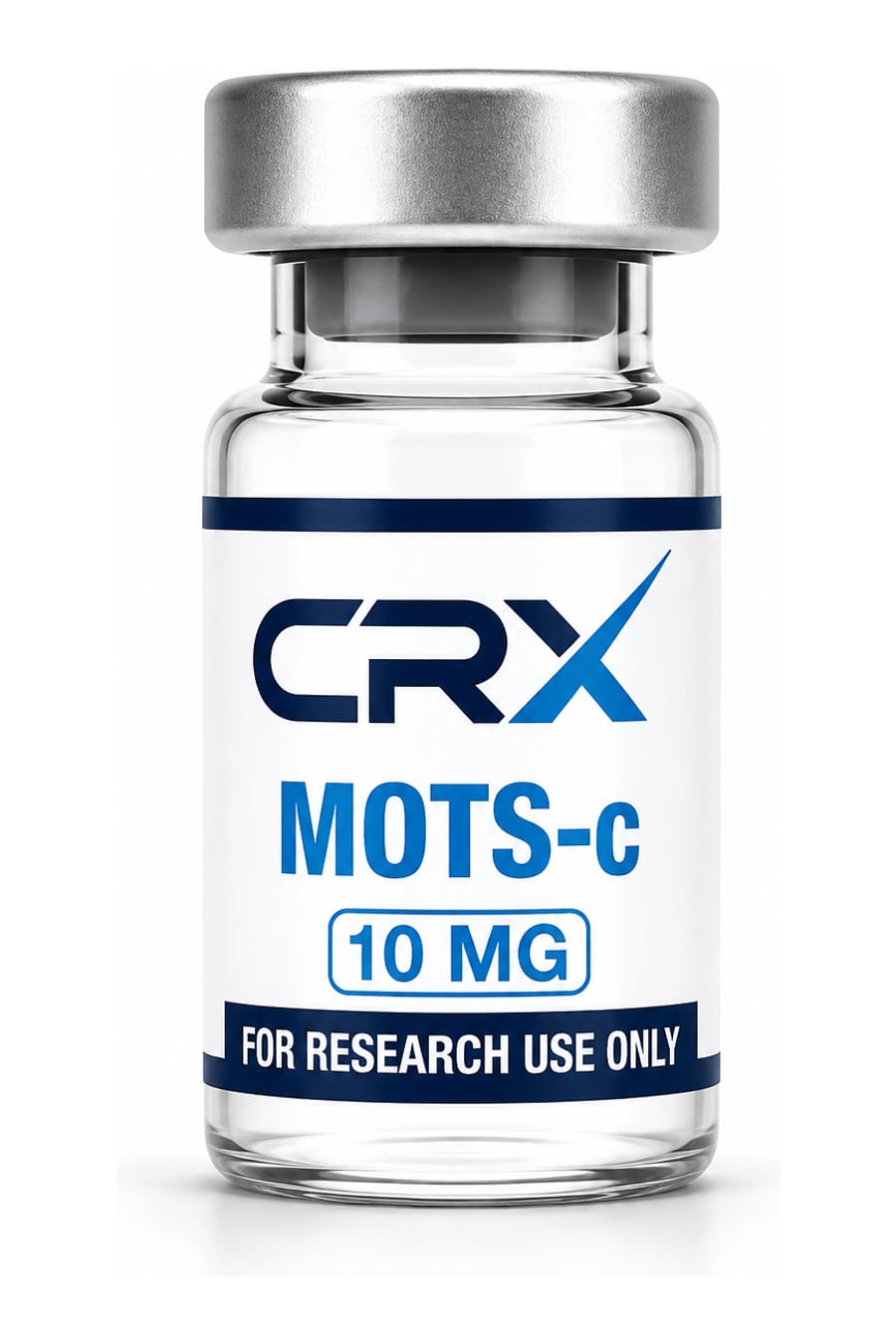
MOTS-c
- Fat loss & metabolism
- Energy & mitochondria
- Longevity & anti-ageing
- Inflammation & immunity
The mitochondrial peptide — studied for endurance, insulin sensitivity and the physical decline that comes with age.
Read the published research →View COAs1 report
| Tested sample | Task number | Analysis date | Measured results | Report |
|---|---|---|---|---|
| 40 mg | 171231 | Jun 22, 2026 | MOTS-c: 45.31 mg · Purity: 98.523% |
What MOTS-c does
MOTS-c is a 16-amino-acid peptide encoded inside mitochondrial DNA rather than the nucleus — a message the mitochondrion sends out to the rest of the body, with skeletal muscle its apparent main target — and it works by activating AMPK, the cell's low-energy sensor. The headline results are about physical capacity: old animals given it for two weeks ran twice as long and 2.16-fold further than untreated old controls, animals first treated at 23.5 months had better grip strength, stride length and walking performance than vehicle at about 30 months, and animals on a 60%-fat diet were protected from becoming obese while eating the same calories as vehicle — all of that in mice, where a lifespan analysis in the same paper reached only a trend. In people MOTS-c has been measured rather than given: one bout of interval cycling raised muscle MOTS-c 11.9-fold above the pre-exercise biopsy in 10 sedentary young men, while in a randomised trial of 30 adults circulating humanin rose significantly after endurance exercise and MOTS-c showed only a trend. Whether low MOTS-c tracks poor metabolic health is unresolved: it was lower in obese boys than in non-obese controls, but a separate study of 85 adults found no difference between people with and without obesity. The one reported caution comes from cell culture, where MOTS-c amplified rather than suppressed the inflammatory secretions of senescent cells.
- Endurance and exercise capacity
- Mitochondrial energy and fatigue
- Insulin sensitivity and metabolic health
- Age-related physical decline
- Muscle strength and walking performance
- Recovery and adaptation from training
Common areas of interest, not measured results. The findings below are the published data.
In a meta-analysis of three cross-sectional Japanese and Hawaiian cohorts totalling 27,527 people (J-MICC, MEC and TMM), men but not women carrying the C allele of the Asian-specific m.1382A>C variant — which substitutes K14Q in MOTS-c — had a higher prevalence of type 2 diabetes than A-allele carriers; within J-MICC the excess was confined to men in the lowest physical-activity tertile. This is an observational genetic association, not an intervention.6
In a cross-sectional case-control study of 40 obese Chinese children and adolescents and 57 non-obese controls, circulating MOTS-c was lower in the obese group (472.61 ± 22.83 versus 561.64 ± 19.19 ng/mL, P < 0.01), a difference driven by boys (465.26 ± 24.53 versus 584.07 ± 21.18 ng/mL, P < 0.001), with no significant difference between girls (P > 0.05).7
In a cross-sectional study of 85 adults — 48 with a body mass index of 30 kg/m² or above and 37 with a body mass index of 18.5–24.9 kg/m² — serum MOTS-c did not differ between the groups (14.33 ± 3.76 versus 13.67 ± 3.44 pg/mL; p = 0.395); in multiple regression only age (inversely) and HOMA-IR (positively) predicted MOTS-c.8
For laboratory research use only. Not a drug, food, or cosmetic. Not for human or veterinary use, ingestion, or any form of consumption. Sold exclusively to qualified researchers.