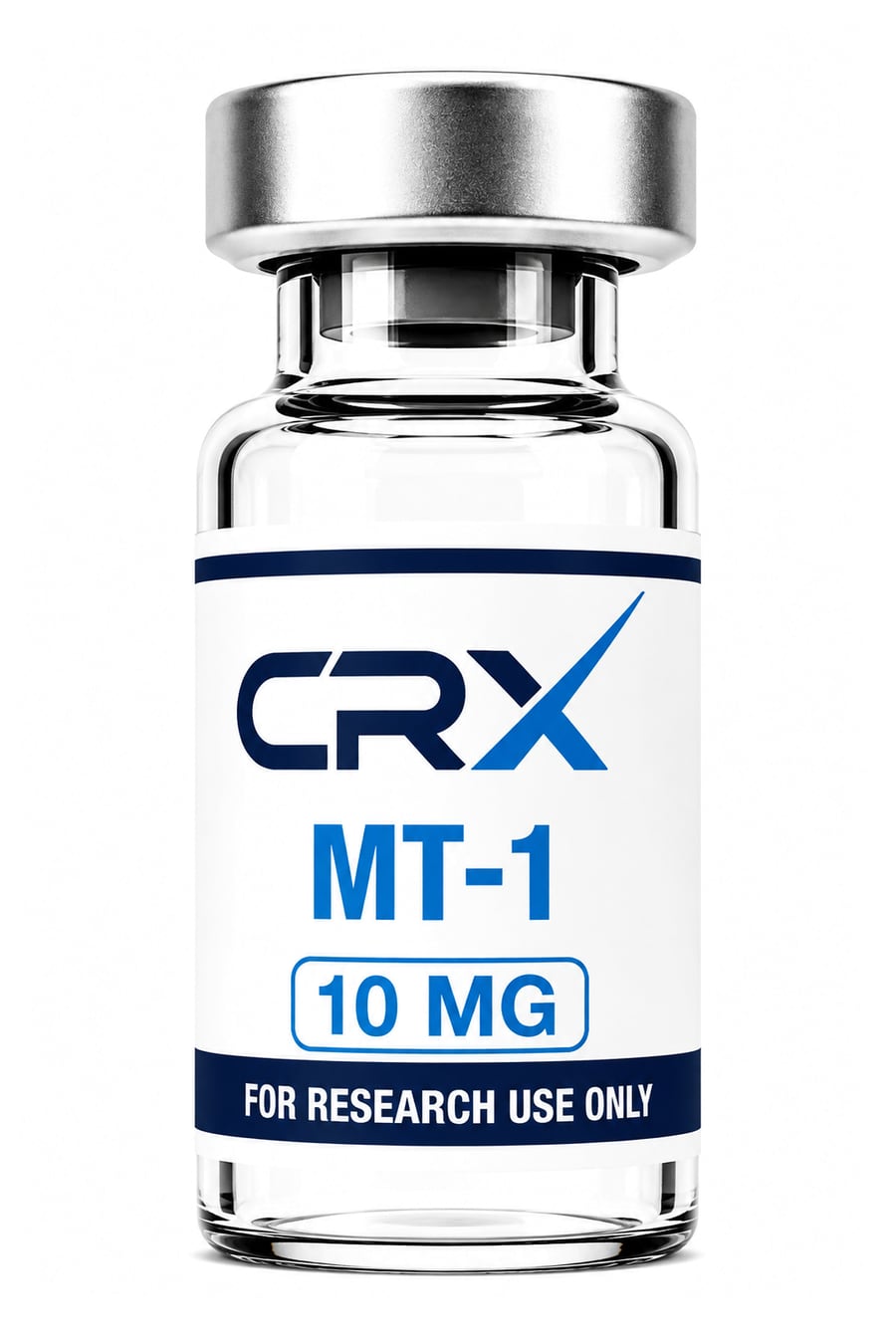
MT-1
- Skin & hair
A melanocortin-1 receptor agonist that drives eumelanin production in the skin without ultraviolet exposure, taking the pigment route to photoprotection rather than filtering light at the surface.
Read the published research →What MT-1 does
MT-1 activates the melanocortin-1 receptor that ultraviolet light would otherwise engage, pushing melanocytes toward eumelanin, the darker pigment that absorbs and scatters light. As afamelanotide it is an approved medicine for erythropoietic protoporphyria, a rare disorder in which minutes of sunlight cause burning pain. Two placebo-controlled phase 3 trials each recorded longer pain-free time in direct sunlight than placebo: 69.4 hours against 40.8 over six months in the United States trial, and, on a separate nine-month measure that cannot be combined with it, 6.0 hours against 0.8 in the European trial. In fair-skinned volunteers a placebo-controlled trial raised melanin density 41% in the subgroup that burns most easily and 12% in the subgroup that burns least, and after an ultraviolet challenge sunburn cells and basal-layer thymine dimers fell against pre-treatment levels. Its most consistent effect is also its most visible: nearly everyone darkens, nausea and headache are the common complaints, and case reports of new, darkening and atypical moles have followed unregulated self-administration of melanotan I or the different peptide melanotan II.
- photoprotection in light-triggered skin conditions
- phototoxic pain and light tolerance in protoporphyria
- melanocortin-1 receptor signalling in melanocytes
- eumelanin versus pheomelanin balance in skin
- adjunct alongside phototherapy in vitiligo
- quality of life in sunlight-avoidant patients
Common areas of interest, not measured results. The findings below are the published data.
In CUV039, a randomised, double-blind, placebo-controlled phase 3 trial in 94 adults with erythropoietic protoporphyria in the United States, the median duration of pain-free time in direct sunlight after 6 months was 69.4 hours with the afamelanotide implant versus 40.8 hours with placebo (P=0.04).5
In CUV029, the companion randomised, double-blind, placebo-controlled phase 3 trial in 74 adults with erythropoietic protoporphyria in the European Union, median pain-free time in direct sunlight after 9 months was 6.0 hours versus 0.8 hours with placebo (P=0.005), and phototoxic reactions numbered 77 versus 146 (P=0.04). The two trials measured exposure over different periods, so their hour counts cannot be pooled or compared.5
In an uncontrolled before-and-after analysis of 39 Swiss patients with erythropoietic protoporphyria in routine care, the median maximum time in sunlight before a phototoxic reaction was 10 minutes (IQR 5-20) before afamelanotide and 180 minutes (IQR 120-240) during treatment, and the median pain score for the worst reaction fell from 10 before to 6 (IQR 3-7) during, on an 11-point scale.6
For laboratory research use only. Not a drug, food, or cosmetic. Not for human or veterinary use, ingestion, or any form of consumption. Sold exclusively to qualified researchers.