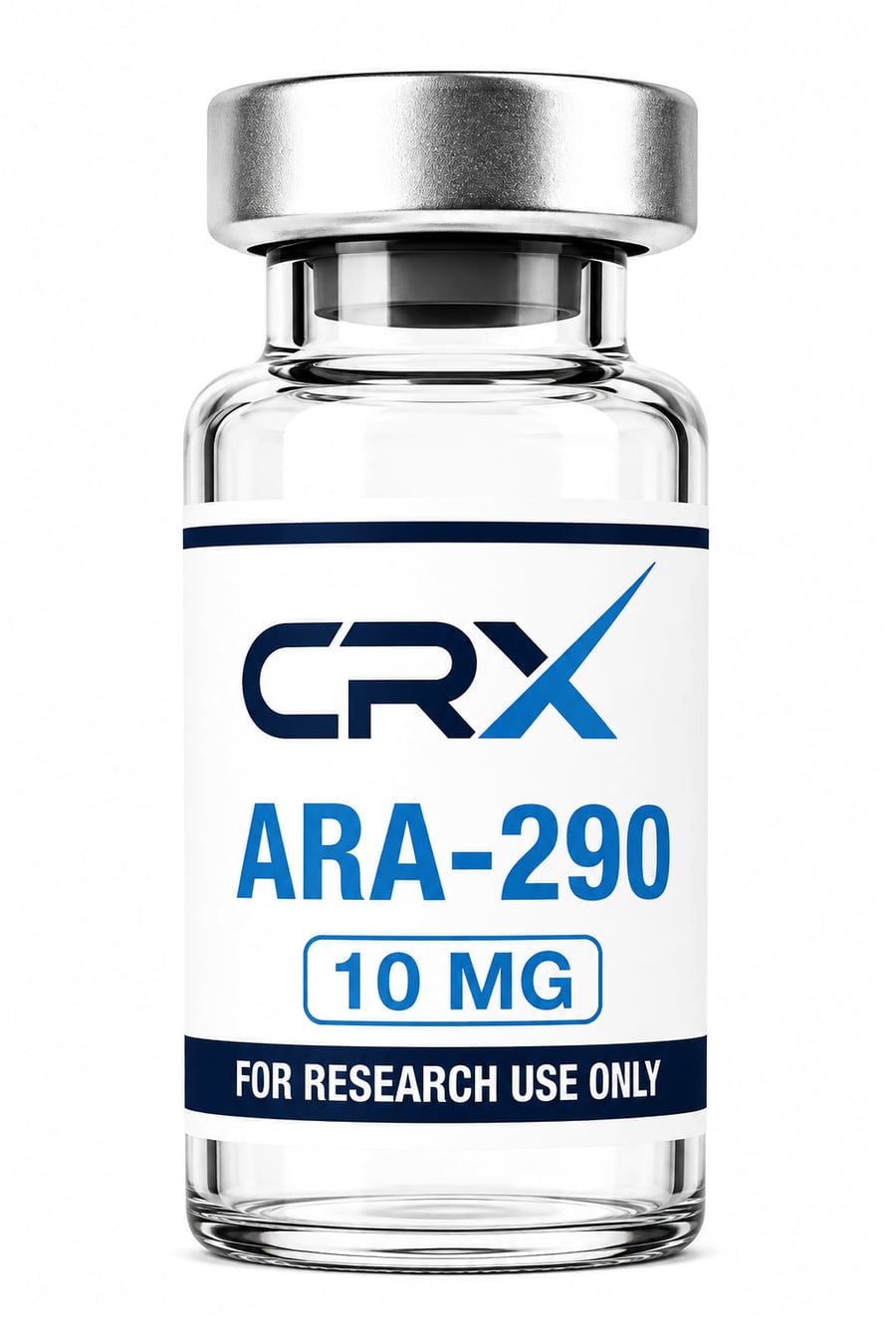
ARA-290
- Recovery & repair
- Inflammation & immunity
- Focus & brain health
- Fat loss & metabolism
An 11-amino-acid peptide modelled on one face of erythropoietin's helix B, built to reach its tissue-repair receptor and not its red-blood-cell one.
Read the published research →What ARA-290 does
Erythropoietin does two unrelated jobs through two different receptors: it makes red blood cells, and it protects and repairs injured tissue. ARA-290 was engineered to keep only the second, engaging a receptor complex that appears where tissue is inflamed or damaged and is largely absent from healthy tissue, and it does not stimulate red cell production. In randomised placebo-controlled trials in adults with sarcoidosis-associated small fibre neuropathy, treatment over 28 days raised corneal nerve fibre area, by 14.5% within the treated arm against a 5.3% fall on placebo in the first trial and, in a later three-dose trial, at the middle dose only, alongside an 18.7 m gain in 6-minute walk distance against a 15.1 m decline on placebo. In 48 adults with type 2 diabetes and painful neuropathy, PainDetect symptom scores improved 3.3 points against 1.1 on placebo and HbA1c fell 0.16% at day 28 against 0.01% on placebo. Not every endpoint has moved: a nine-patient single-arm study in diabetic macular oedema found no change in visual acuity, retinal thickness or retinal sensitivity over 12 weeks, and the wider claims about inflammation, cardiac ageing and cognition rest on rat and mouse work.
- small fibre neuropathy and nerve regrowth
- neuropathic pain of inflammatory origin
- sarcoidosis-associated nerve fibre loss
- innate repair receptor and inflammation research
- erythropoietin biology without erythropoiesis
- tissue protection after ischaemic injury
Common areas of interest, not measured results. The findings below are the published data.
In a randomised, placebo-controlled trial in 38 adults with sarcoidosis-associated small nerve fibre loss (21 on ARA 290, 17 on placebo), 28 days of daily subcutaneous dosing raised median corneal nerve fibre area 14.5% within the treated arm (p = 0.022) while placebo fell 5.3% (p = 0.462); 6-minute walk distance rose 18.7 m versus a 15.1 m decline on placebo (between-group p = 0.049). A 2016 erratum rescales the paper's absolute areas, not these percentages.5,6
In a 28-day phase 2b randomised trial in 64 adults with sarcoidosis-associated small nerve fibre loss, only one of three dose arms (4 mg) showed a significant placebo-corrected increase in corneal nerve fibre area (p = 0.012); the 1 mg and 8 mg arms did not, their confidence intervals spanning zero. Intraepidermal GAP-43+ regenerating fibres also rose at 4 mg (p = 0.035). Absolute areas are omitted: their measurement scale is unconfirmed.7
In a phase 2 randomised trial in 48 adults with type 2 diabetes and painful neuropathy (24 per arm), 28 days of daily ARA 290 improved PainDetect symptom scores by 3.3 points versus 1.1 on placebo at day 28 (p = 0.037). In a subgroup with corneal nerve fibre density more than one standard deviation below normal, density rose within the treated arm only (+2.6 fibres/mm2, paired p = 0.02); placebo did not change.8
For laboratory research use only. Not a drug, food, or cosmetic. Not for human or veterinary use, ingestion, or any form of consumption. Sold exclusively to qualified researchers.