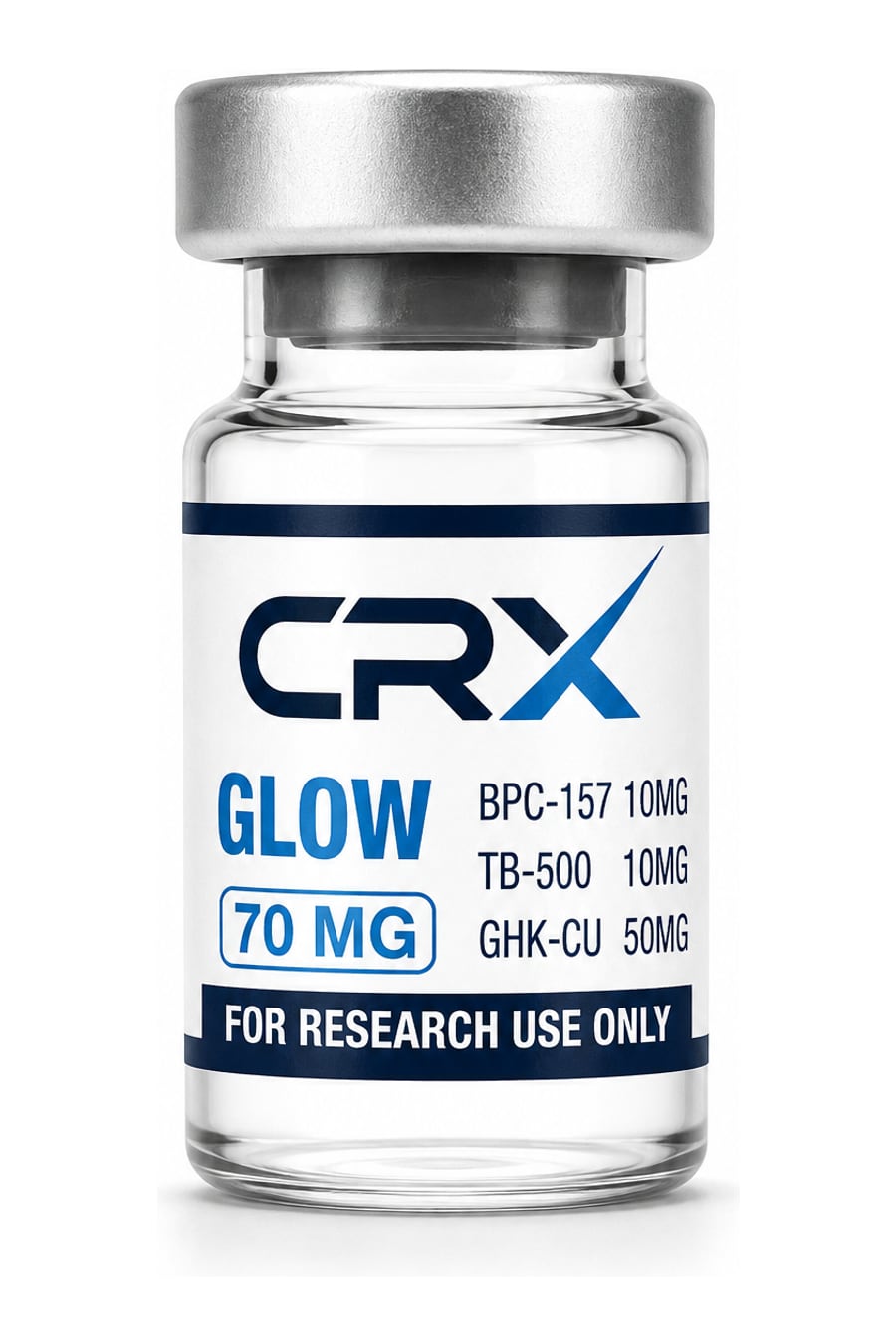
Glow 70
- Recovery & repair
- Skin & hair
The repair stack — BPC-157, TB-500 and GHK-Cu in one vial, for soft-tissue recovery, wound closure and skin collagen.
Read the published research →View COAs1 report
| Tested sample | Task number | Analysis date | Measured results | Report |
|---|---|---|---|---|
| 70 mg | 137060 | Apr 30, 2026 | GHK-Cu (GHK content): 48.35 mg · BPC-157: 10.49 mg · TB-500 (TB4): 10.48 mg |
What Glow 70 does
Glow 70 is a blend rather than a molecule, and the three parts are grouped by a shared claim about tissue repair rather than a shared target: no study has ever given all three together, so everything known about them belongs to one of them alone. GHK-Cu is the copper-carrying tripeptide behind the skin and collagen side — applied topically it reached 98.5% median ulcer closure against 60.8% for vehicle in diabetic foot ulcers and raised collagen, DNA and glycosaminoglycan content in wound chambers, while on venous stasis ulcers a copper tripeptide cream was no better than inert vehicle. TB-500 / thymosin β4 is the actin-binding piece and the one with real systemic human exposure: in full-thickness wounds it sped re-epithelialisation 42% over saline at day 4 and up to 61% at day 7, while a phase 2 dry-eye trial in 72 people missed both primary endpoints. BPC-157 is the least defined of the three, a gastric-juice peptide whose strongest evidence is VEGFR2 activation in cultured human endothelial cells and faster healing of surgically transected Achilles tendons — and most of that repair work, GHK-Cu's included, is in rats and cell culture. Intravenous thymosin β4 in 40 healthy volunteers produced only infrequent mild-to-moderate adverse events with no dose-limiting toxicity, and infection during topical GHK-Cu treatment ran at 7% of ulcers against 34% on vehicle.
- Soft-tissue and tendon recovery
- Skin quality, glow and collagen support
- Post-injury and post-surgical repair
- Joint comfort after hard training
- Wound and scar healing
- Gut lining comfort
Common areas of interest, not measured results. The findings below are the published data.
In a multicentre randomised evaluator-blinded placebo-controlled trial in patients with diabetic neuropathic plantar ulcers, all receiving sharp debridement and pressure-relieving footwear, topical GHK-Cu gel reached 98.5% median area closure versus 60.8% for vehicle (p < 0.05); in ulcers larger than 100 mm² the separation was 89.2% versus −10.3% for vehicle (p < 0.01).20
In a prospective randomised evaluator-blinded trial in 86 patients with venous stasis ulcers, a 0.4% tripeptide copper complex cream did not differ from inert vehicle in ulcer size reduction, while 1% silver sulfadiazine was statistically superior to both.21
In a single-centre double-masked placebo-controlled phase 2 trial in 72 subjects with moderate-to-severe dry eye under a controlled adverse environment model, thymosin β4 ophthalmic solution missed both primary endpoints: neither ocular discomfort nor inferior corneal staining differed significantly from placebo. Several secondary endpoints did, including a 27% reduction in discomfort scores on day 28 versus placebo (p = 0.0244) and improved central and superior corneal staining versus control (p = 0.0075 and p = 0.0210).22
For laboratory research use only. Not a drug, food, or cosmetic. Not for human or veterinary use, ingestion, or any form of consumption. Sold exclusively to qualified researchers.