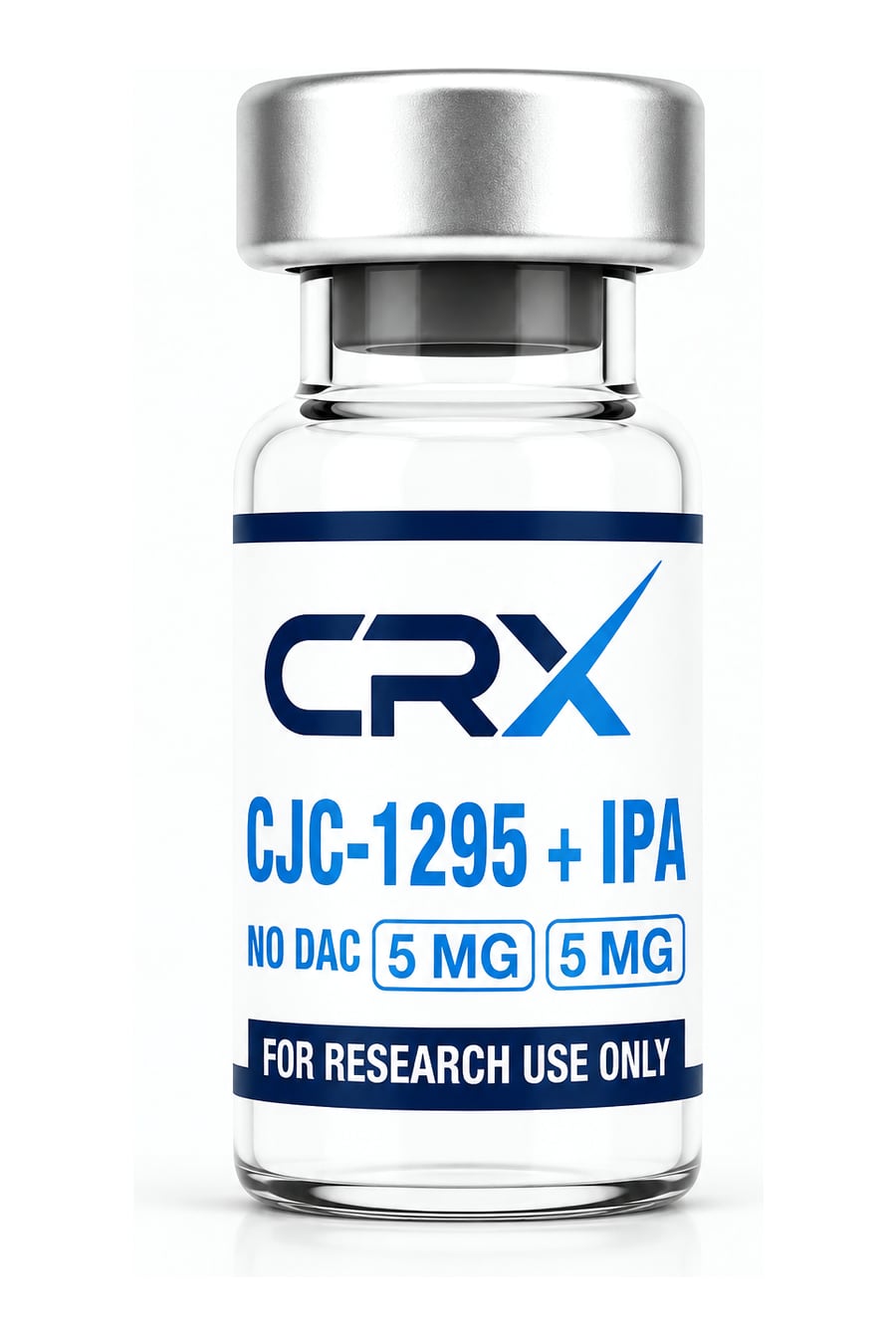
CJC-1295 (No DAC) + Ipamorelin
- Growth hormone
- Fat loss & metabolism
- Recovery & repair
Two routes into the same growth-hormone signal — a GHRH-receptor analogue paired with ipamorelin, the selective growth-hormone secretagogue.
Read the published research →View COAs1 report
| Tested sample | Task number | Analysis date | Measured results | Report |
|---|---|---|---|---|
| 5 mg + 5 mg | 152928 | May 15, 2026 | Ipamorelin: 4.58 mg · CJC-1295 DAC: Not detected · CJC-1295 (mod GRF 1-29): 4.99 mg |
What CJC-1295 (No DAC) + Ipamorelin does
The two halves reach the same pituitary cell through different receptors: the CJC-1295 backbone is a GHRH-receptor agonist, ipamorelin an agonist at the ghrelin receptor GHS-R1a. The case for pairing the classes is that a GHRH analogue plus a growth-hormone-releasing peptide produces a synergistic pulse, which was shown with GHRP-2 in 47 men rather than with ipamorelin. Ipamorelin's distinguishing property is selectivity: it matched GHRP-6 on growth hormone release while, unlike GHRP-6 and GHRP-2, leaving ACTH and cortisol no higher than GHRH did — measured in conscious swine. Every human growth-hormone and IGF-I number published under the CJC-1295 name belongs to the albumin-binding DAC form, a different molecule from the no-DAC peptide in this blend, which raised growth hormone 2- to 10-fold and IGF-I 1.5- to 3-fold against placebo in healthy adults. Ipamorelin was well tolerated in a 114-patient phase 2 trial after bowel surgery, with adverse events in 87.5% of the treated group against 94.8% on placebo, and reviews of this peptide class report prolactin and cortisol elevation, appetite change and dysglycaemia, fluid retention, joint and muscle aches and injection-site reactions.
- Growth hormone support in adults
- Sleep quality and overnight recovery
- Recovery between hard training blocks
- Age-related decline in growth hormone
- Two pathways to the same pituitary signal
Common areas of interest, not measured results. The findings below are the published data.
The human GH and IGF-I data published under the CJC-1295 name come from the albumin-binding DAC form, not the no-DAC constituent in this blend: in two randomised, double-blind, placebo-controlled ascending-dose trials in healthy adults aged 21 to 61, a single subcutaneous injection produced dose-dependent increases in mean plasma GH of 2- to 10-fold for 6 days or more and in mean plasma IGF-I of 1.5- to 3-fold for 9 to 11 days, with an estimated half-life of 5.8 to 8.1 days; after multiple doses mean IGF-I remained above baseline for up to 28 days.8
In healthy men aged 20 to 40 sampled every 20 minutes across a 12-hour overnight window, a single injection of CJC-1295 with DAC given one week earlier raised trough GH 7.5-fold (P < 0.0001), mean GH 46% (P < 0.01) and IGF-I 45% (P < 0.001) against each man's own pre-injection profile, with GH pulse frequency and magnitude unchanged. This was uncontrolled, with no placebo arm.9
In healthy male volunteers given 15-minute intravenous ipamorelin infusions at five ascending dose levels with eight men per level, kinetics were dose-proportional, with a terminal half-life of 2 hours, clearance of 0.078 L/h/kg and steady-state volume of distribution of 0.22 L/kg; a single episode of GH release peaked at 0.67 hours, and half-maximal GH stimulation (SC50) occurred at 214 nmol/L.10
For laboratory research use only. Not a drug, food, or cosmetic. Not for human or veterinary use, ingestion, or any form of consumption. Sold exclusively to qualified researchers.