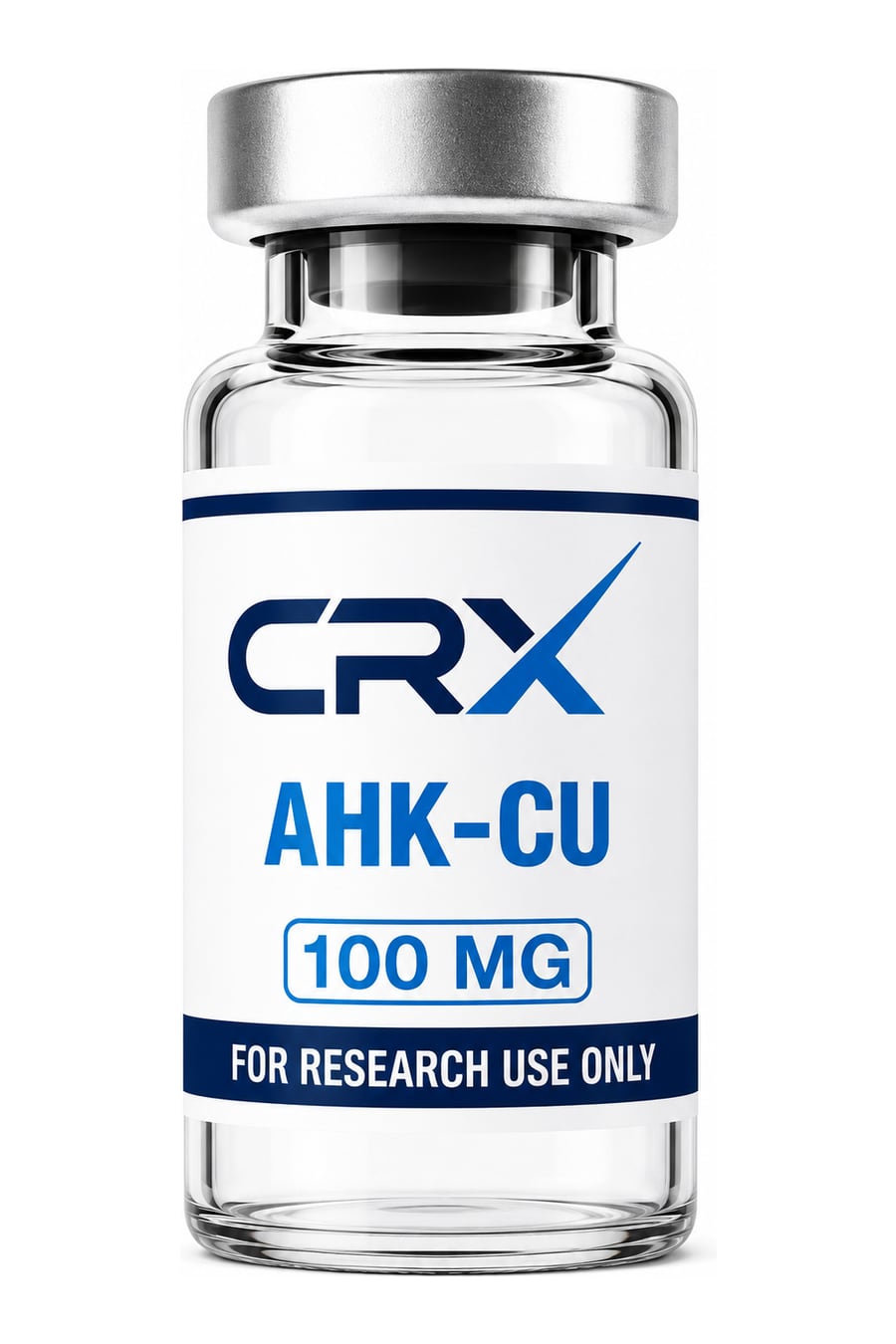
AHK-Cu
- Skin & hair
- Recovery & repair
The copper peptide for hair — studied for follicle growth and the cells that drive it, built on the same copper-binding chemistry as GHK-Cu.
Read the published research →What AHK-Cu does
AHK-Cu carries copper on the same Xaa-His-Lys binding site as GHK-Cu, with alanine where GHK has glycine, and the work behind it is about hair. Human hair follicles kept alive in organ culture elongated more than untreated control follicles, and dermal papilla cells — the cells that instruct follicle growth — divided more than untreated cells. The proposed reason is anti-apoptotic: treated dermal papilla cells showed a higher Bcl-2/Bax ratio and less cleaved caspase-3 and PARP, though the drop in apoptotic cells counted by flow cytometry was not statistically significant. All of that is laboratory work on human tissue and cells, and it traces to one 2007 experiment. One thing worth separating out: the VEGF and blood-supply story usually attached to copper peptides belongs to GHK-Cu and to VEGF-overexpressing mice, not to this molecule.
- Hair thinning and follicle support
- Scalp and hair-growth topicals
- Copper peptide skincare formulations
- Skin firmness and appearance
- A close alternative to GHK-Cu
Common areas of interest, not measured results. The findings below are the published data.
In ex vivo organ-cultured human hair follicles, AHK-Cu at 10⁻¹² to 10⁻⁹ M stimulated follicle elongation relative to untreated control follicles.1
In cultured human dermal papilla cells — the fibroblasts that govern follicle morphogenesis — AHK-Cu over the same 10⁻¹² to 10⁻⁹ M range increased proliferation relative to untreated cells.1
In cultured human dermal papilla cells, 10⁻⁹ M AHK-Cu raised the Bcl-2/Bax ratio and lowered cleaved caspase-3 and cleaved PARP versus untreated cells; the accompanying fall in annexin V/propidium iodide-positive apoptotic cells was not statistically significant.1
For laboratory research use only. Not a drug, food, or cosmetic. Not for human or veterinary use, ingestion, or any form of consumption. Sold exclusively to qualified researchers.