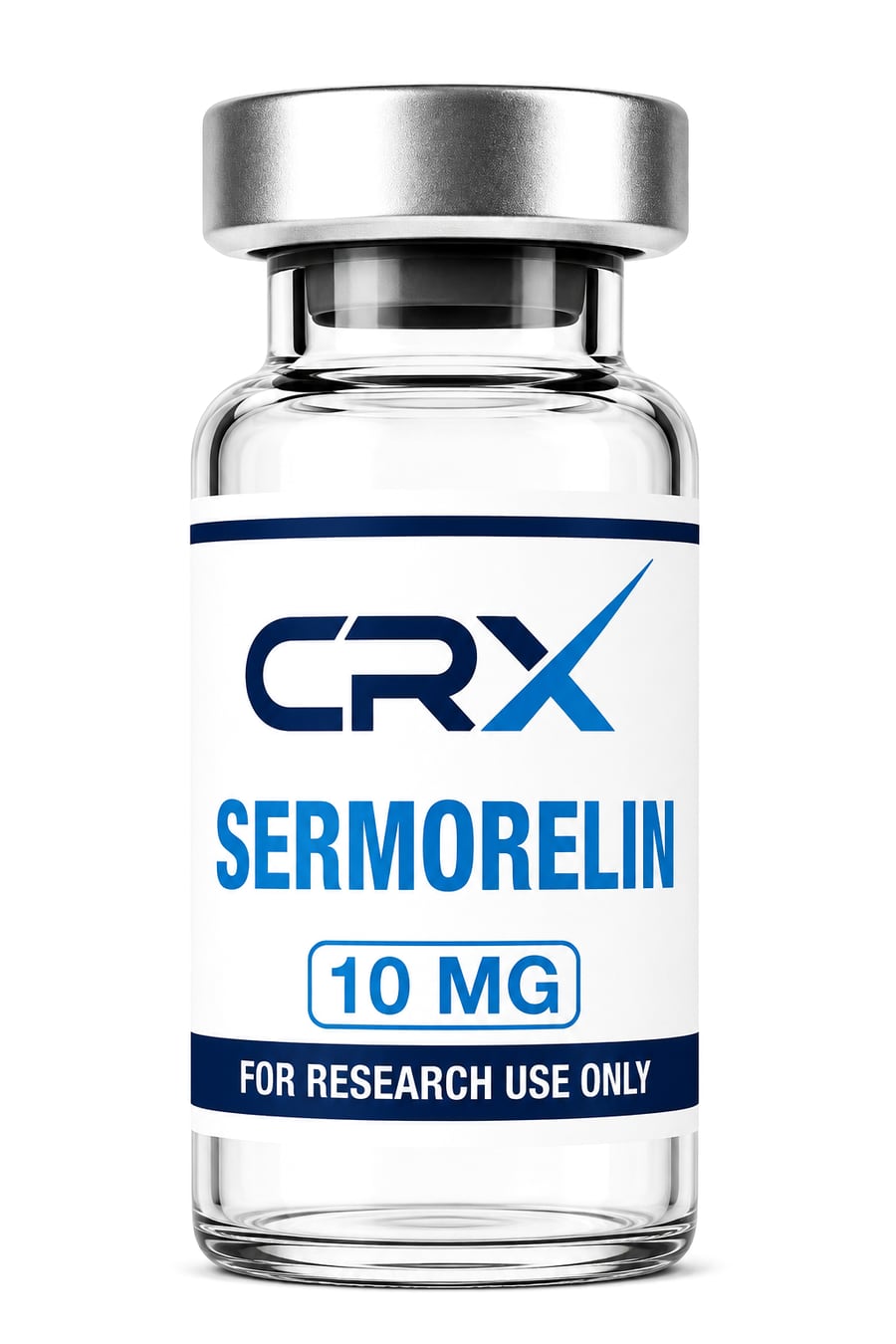
Sermorelin
- Growth hormone
- Fat loss & metabolism
The growth-hormone peptide that prompts your own pituitary rather than replacing the hormone — enough, in older men, to bring 24-hour growth hormone and IGF-I to the levels of untreated men in their twenties.
Read the published research →What Sermorelin does
Sermorelin is the shortest fragment of growth hormone-releasing hormone that still does the full job — 29 amino acids — and it prompts the pituitary to release its own growth hormone rather than supplying hormone from outside, so the effect tracks how much pituitary reserve is left. Its clearest human result came in healthy men averaging 68 years: over fourteen days, the higher-dose arm raised 24-hour growth hormone and IGF-I above each man's own baseline to levels no different from untreated men in their twenties, while the lower-dose arm moved neither. Schedule decides whether the downstream limb engages at all — an evening-only regimen in older men lifted nocturnal growth hormone but left IGF-I, body fat, muscle, lipids and glucose unchanged over six weeks, with 2 of 6 strength measures improving. Against recombinant growth hormone in children with growth hormone deficiency it came second: height velocity of 9.2 and 9.3 cm/yr across its two arms, against 14.6 cm/yr on growth hormone. Nearly every child treated developed anti-GHRH antibodies that faded once treatment stopped, flushing and injection-site pain were the most common complaints, and rated sleep quality got slightly worse rather than better in older adults.
- Raising your own growth hormone rather than replacing it
- Age-related decline in growth hormone output
- Body composition, fat mass against lean mass
- Skin thickness and tissue quality
- IGF-1 as a tracked marker
Common areas of interest, not measured results. The findings below are the published data.
In a randomised 6-month trial in 60 children with growth hormone deficiency of hypothalamic origin, mean height velocity reached 9.2 and 9.3 cm/yr on the 30 and 60 microgram/kg/day GHRH(1-29)-NH2 arms versus 14.6 cm/yr on recombinant growth hormone (p < 0.01 for growth hormone versus either GHRH arm). Serum IGF-I rose initially on GHRH, then fell back to near pretreatment values.12
In an uncontrolled open-label multicentre study of 110 previously untreated prepubertal children with growth hormone deficiency — of whom 86 were eligible for the efficacy analysis — subcutaneous GHRH(1-29) raised mean height velocity from 4.1 +/- 0.9 cm/yr at baseline to 8.0 +/- 1.5 cm/yr at 6 months and 7.2 +/- 1.3 cm/yr at 12 months, with 74% classed as good responders at 6 months. There was no placebo or active comparator arm.9
In 10 healthy old men (68.0 +/- 6.2 years), 14 days of twice-daily GHRH-(1-29) at the 1 mg dose raised mean 24-hour growth hormone (p < 0.001) and IGF-I (p < 0.005) above the men's own basal values, to levels that no longer differed from 9 untreated young men (26.2 +/- 4.1 years); the 0.5 mg dose did not reach significance. There was no placebo arm.7
For laboratory research use only. Not a drug, food, or cosmetic. Not for human or veterinary use, ingestion, or any form of consumption. Sold exclusively to qualified researchers.