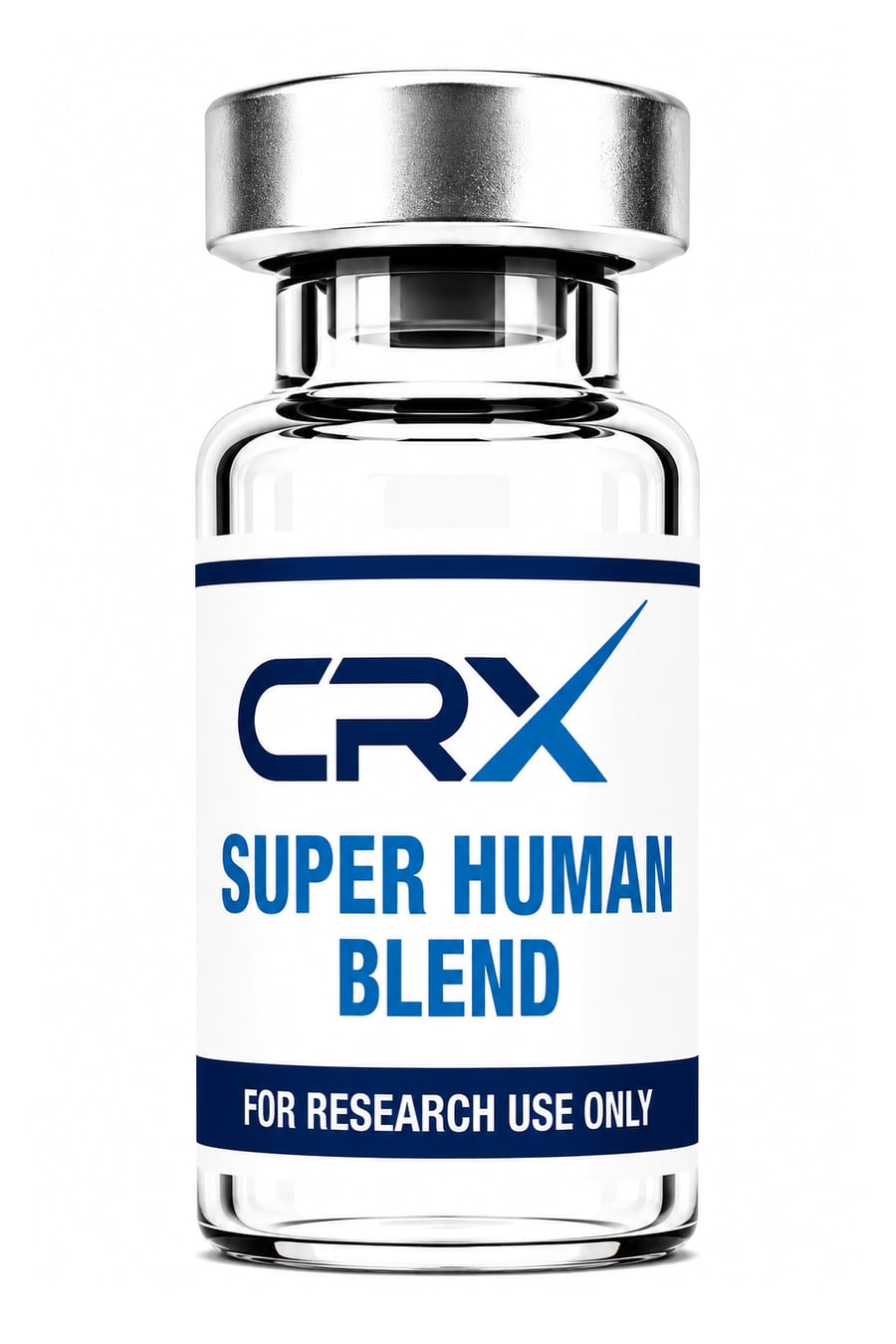
Super Human Blend
- Fat loss & metabolism
- Energy & mitochondria
- Growth hormone
- Recovery & repair
- Inflammation & immunity
A single-vial formulation of nine amino acids and amino-acid derivatives, led by L-carnitine, L-citrulline and L-arginine.
Read the published research →What Super Human Blend does
Super Human Blend puts nine amino acids and derivatives in one vial: L-carnitine, L-citrulline, L-arginine, L-ornithine, N-acetylcysteine, L-lysine, L-proline, L-taurine and L-glutamine. No published study has tested this mixture, so the research below is for single constituents studied on their own, most of it at gram-scale doses rather than the far smaller amounts here. L-carnitine has the deepest literature, with pooled randomised trials reporting small reductions in body weight, fat mass, HbA1c and inflammatory markers, yet a year of intravenous carnitine at several times this vial's amount changed nothing clinically. Arginine raises growth hormone when infused at roughly two hundred and seventy times what is here, and increases collagen deposited into an implanted graft at gram-scale oral doses, while gram-scale oral citrulline raised plasma arginine without improving flow-mediated vasodilation. What that research describes is what these molecules do at those doses by those routes; it does not describe what this vial does.
- fatty-acid transport into mitochondria
- nitric oxide and vascular signalling
- wound collagen deposition
- antioxidant and redox chemistry
- growth hormone response to arginine
- inflammatory marker profiles
Common areas of interest, not measured results. The findings below are the published data.
In the CARNIDIAL trial, 92 incident haemodialysis patients received 1 g of intravenous l-carnitine after each dialysis session, or placebo, for one year. Plasma carnitine rose from 79 to 258 micromol/L on carnitine while placebo fell from 68 to 53, yet erythropoietin resistance improved no more than with placebo (P=0.7). This is intravenous carnitine at 1 g per session, about 4.5 times this vial's 220 mg, and the clinical result was null.8
In a double-blind, randomised, placebo-controlled crossover study, 20 healthy volunteers took oral l-citrulline or l-arginine regimens for a week each. Citrulline raised plasma arginine AUC and Cmax more than arginine did (P<0.01); at 3 g twice daily — 6 g/day by mouth against 120 mg here — it raised the arginine/ADMA ratio from 186 to 278 and urinary nitrate and cGMP. No regimen improved flow-mediated vasodilation over baseline.1
In six healthy men, 30 g of arginine infused intravenously over 30 minutes and followed by 200 micrograms of TRH raised mean serum growth hormone from 0.6 to 23.3 micrograms/L at 60 minutes — below the 44.9 reached by a GHRH bolus alone. Arginine did not release growth hormone from rat anterior pituitary cells in vitro, implicating suppression of endogenous somatostatin. The infused dose is roughly 270 times this vial's 110 mg.9
For laboratory research use only. Not a drug, food, or cosmetic. Not for human or veterinary use, ingestion, or any form of consumption. Sold exclusively to qualified researchers.