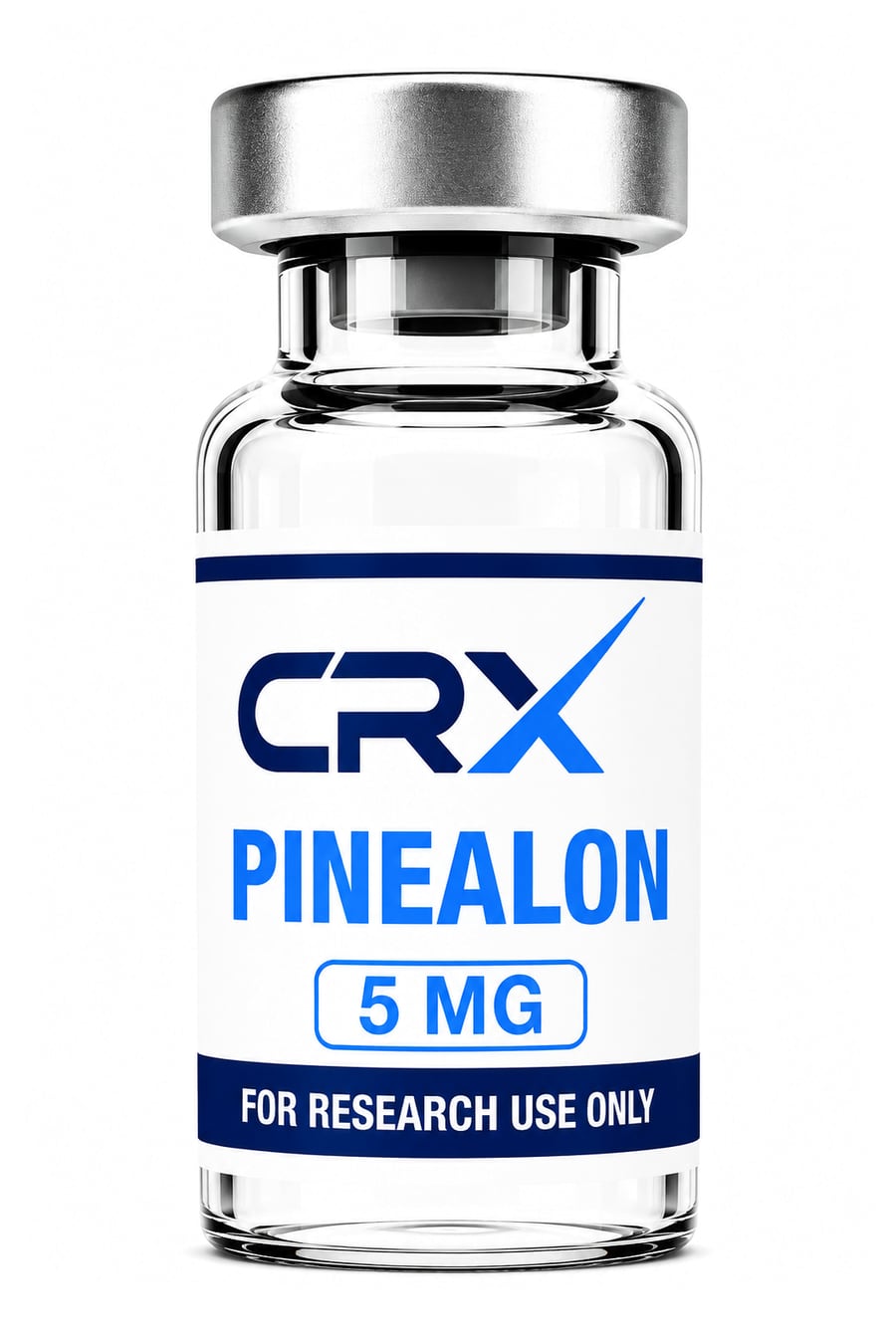
Pinealon
- Focus & brain health
- Longevity & anti-ageing
The tripeptide Glu-Asp-Arg from the Russian short-peptide programme, studied as a neuroprotective and geroprotective candidate.
Read the published research →What Pinealon does
Pinealon is the tripeptide Glu-Asp-Arg, developed within a family of short peptides studied for neuroprotection and healthy ageing. Labelled peptide enters cell nuclei and binds selectively to DNA and to histone tails, which is the basis for the claim that it acts on gene expression rather than through a surface receptor. The work that has measured effects is cell-culture and rodent: under amyloid stress it returned mushroom dendritic spine counts to the untreated control level, in neurons grown from elderly donors' skin cells it lowered oxidative DNA damage and lengthened dendrites, it improved maze learning after hypoxia, and given to dams on a methionine load it improved the offspring's spatial learning while reducing reactive oxygen species and necrosis in their cerebellar neurons. It is not uniformly favourable: in pineal-gland and aged-skin explant assays it produced no effect while a sibling peptide did, one report has it raising intracellular reactive oxygen species rather than lowering them, and the comparator cortexin outperformed it on free-radical and caspase-3 endpoints.
- cognitive and memory support
- neuroprotection under oxidative or hypoxic stress
- age-related cognitive decline research
- general geroprotective stacks
- companion to other Khavinson short peptides
Common areas of interest, not measured results. The findings below are the published data.
The only identified human report is an uncontrolled open Russian gerontology study of 32 patients aged 41 to 83 with chronic polymorbidity and organic brain syndrome in remission, with no placebo, no randomisation and no blinding. Pinealon and vesugen were given together, so no effect is attributable to pinealon alone; the authors described an anabolic effect and slowed biological-age indicators, and judged vesugen more effective than pinealon.19
In 5xFAD-M transgenic mice, a genetic model of Alzheimer's disease, intraperitoneal EDR prevented the dendritic spine loss seen in saline-injected transgenic animals; the neuroplasticity trend in the same paper came from the KED arm, not EDR. A 2025 correction states its confocal dendrite images for the male and female cohorts were one figure published twice; replacements were supplied and the conclusions stated unchanged.6,8
In rats made hyperhomocysteinemic by dietary methionine loading during pregnancy, pinealon given to the dams improved the offspring's spatial orientation and learning and reduced both reactive oxygen species accumulation and the number of necrotic cells among isolated cerebellar neurons, compared with untreated hyperhomocysteinemic offspring.9
For laboratory research use only. Not a drug, food, or cosmetic. Not for human or veterinary use, ingestion, or any form of consumption. Sold exclusively to qualified researchers.