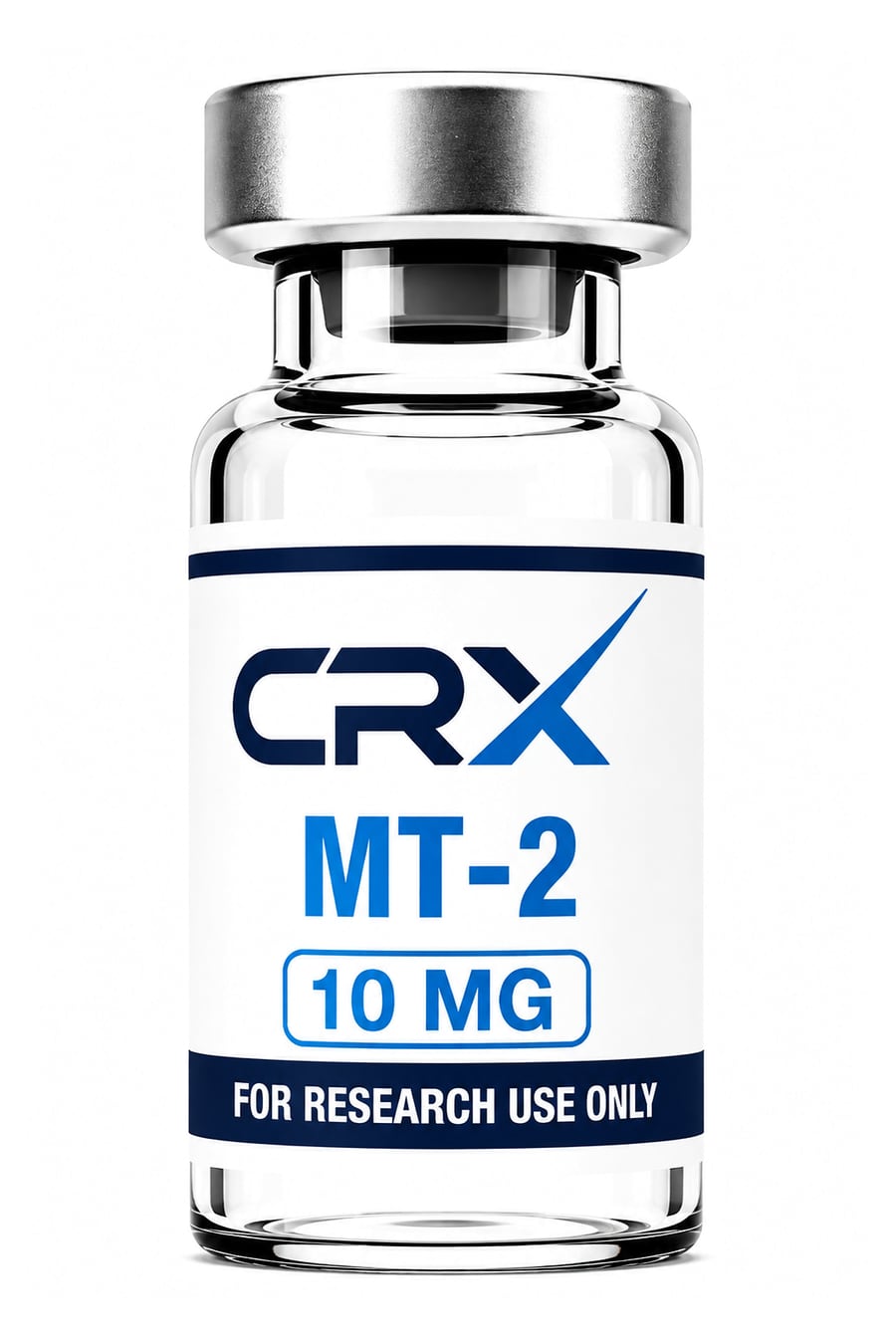
MT-2
- Skin & hair
- Libido & sexual health
- Fat loss & metabolism
A synthetic analogue of the body's own alpha-MSH signal, studied for skin pigmentation and for erectile response.
Read the published research →View COAs1 report
| Tested sample | Task number | Analysis date | Measured results | Report |
|---|---|---|---|---|
| 10 mg | 137015 | Apr 29, 2026 | Melanotan 2: 10.13 mg · Purity: 99.756% |
What MT-2 does
MT-2 is a ring-closed copy of the body's alpha-MSH signal that activates the melanocortin receptors broadly rather than selectively. Its human record is three small studies from one University of Arizona group between 1996 and 2000: a three-person phase I study in which 2 of 3 volunteers showed increased pigmentation, and two ten-man double-blind placebo-controlled crossover studies in men with erectile dysfunction, where mean tip rigidity above 80% lasted 38.0 minutes against 3.0 on vehicle in one and 45.3 against 1.9 in the other, with higher self-rated sexual desire in the later study. Its appetite and body-composition effects were measured in rats given the peptide directly into the brain, where it cut caloric intake and produced fat-mass loss that pair-feeding did not reproduce. Nausea, a stretching-and-yawning complex and reduced appetite were more frequent after MT-2 than after placebo in those crossover studies, and what has been published since is largely case reports from unregulated use: melanoma, atypical and eruptive moles, rhabdomyolysis with renal injury, renal infarction, priapism and posterior reversible encephalopathy. Vials sold online have been assayed at 43% to 88% of their labelled peptide content, with vials from two of the three shops also carrying unidentified impurities.
- melanocortin receptor signalling
- skin pigmentation independent of sun exposure
- erectile response research
- sexual desire and arousal signalling
- appetite and food-intake research
- body-composition change in preclinical models
Common areas of interest, not measured results. The findings below are the published data.
In a 1996 single-blind, alternating-day, placebo-controlled pilot phase I study in 3 healthy male volunteers, 2 of the 3 had increased pigmentation of the face, upper body and buttock on both quantitative reflectance and visual assessment, measured one week after two weeks of subcutaneous dosing ended.2
In a 2026 single-patient case report with three months of follow-up, a person who self-injected MT-2 over a 64-day period for tanning had brown pigmentation on the attached gingiva of both arches and on both buccal mucosae; one month after stopping, the buccal pigmentation had nearly disappeared, while at three months the gingival pigmentation persisted at reduced intensity.9
In a 1998 double-blind, placebo-controlled crossover study in 10 men with erectile dysfunction of no known organic cause, RigiScan monitoring across a 6-hour window recorded mean tip rigidity above 80 percent lasting 38.0 minutes after MT-2 versus 3.0 minutes after vehicle placebo (p=0.0045); clinically apparent erections developed in 8 of the 10 men.3
For laboratory research use only. Not a drug, food, or cosmetic. Not for human or veterinary use, ingestion, or any form of consumption. Sold exclusively to qualified researchers.