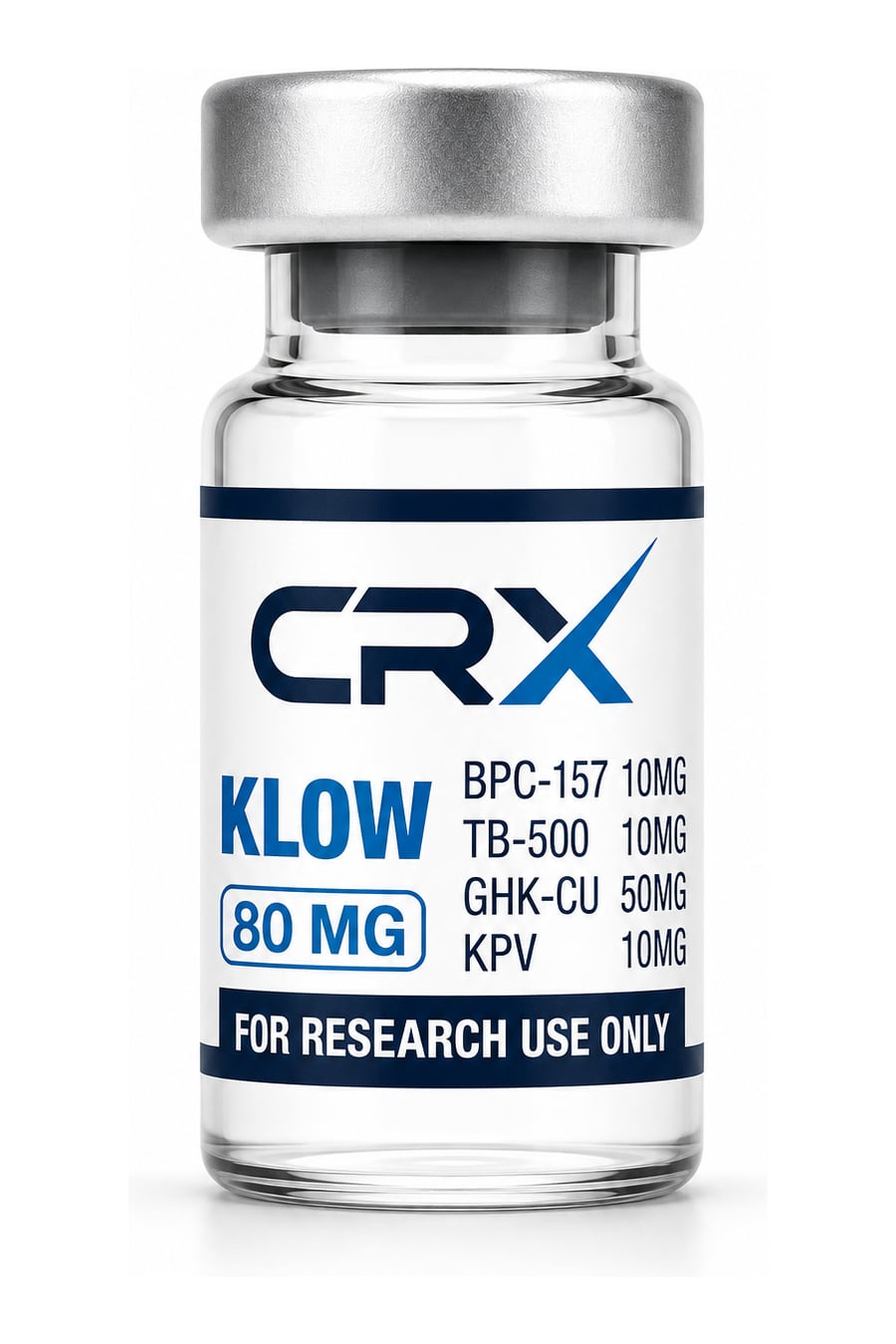
Klow 80
- Recovery & repair
- Inflammation & immunity
The repair stack — four peptides in one vial: BPC-157 and TB-500 for tissue, KPV for inflammation, GHK-Cu for skin and collagen.
Read the published research →View COAs1 report
| Tested sample | Task number | Analysis date | Measured results | Report |
|---|---|---|---|---|
| 80 mg | 152878 | May 15, 2026 | GHK-Cu (GHK content): 50.59 mg · BPC-157: 11.44 mg · TB-500 (TB4): 10.68 mg · KPV: 10.90 mg |
What Klow 80 does
Klow 80 is a mixture rather than a molecule, built to cover repair and inflammation at the same time: BPC-157 and thymosin beta-4 (sold as TB-500) for tissue, KPV for inflammation, and GHK-Cu, a copper-carrying tripeptide, for skin and collagen — four peptides sold together, each of them studied on its own rather than as a combination. The strongest single result belongs to GHK-Cu: a topical gel closed 98.5% of diabetic foot ulcer area against 60.8% on vehicle, with infection in 7% of treated ulcers against 34% of vehicle-treated ones. Thymosin beta-4 raised re-epithelialisation 42% over saline at day 4 and as much as 61% at day 7, and BPC-157 produced stronger, better-scoring tendons than saline after Achilles transection — that work is in rats, and it does not all run one way, since a copper tripeptide cream failed to beat vehicle in venous stasis ulcers, where silver sulfadiazine beat both. The largest safety dataset behind any one constituent is a phase 1 trial of recombinant thymosin beta-4 in 84 volunteers, where adverse events were mild to moderate and none were serious.
- Soft-tissue, tendon and joint recovery
- Wound healing and scar quality
- Gut lining and systemic inflammation
- Collagen support and skin appearance
- Stacking repair and anti-inflammatory action
- Returning to training after an injury
Common areas of interest, not measured results. The findings below are the published data.
In a multicentre randomised evaluator-blinded placebo-controlled trial in patients with diabetic neuropathic plantar ulcers, all of whom received sharp debridement at entry and pressure-relieving footwear, topical GHK-Cu gel produced 98.5% median percentage area closure versus 60.8% for vehicle (p < 0.05). Among ulcers treated immediately after the initial debridement, infection occurred in 7% of GHK-Cu-treated ulcers versus 34% of vehicle-treated ulcers (p < 0.05).14
In a prospective randomised evaluator-blinded trial in 86 evaluable patients with venous stasis ulcers, a 0.4% tripeptide copper complex cream did not differ from inert vehicle placebo in ulcer size reduction, while 1% silver sulfadiazine cream was statistically superior to both.15
In a rat full-thickness skin wound model, thymosin beta-4 applied topically or intraperitoneally increased re-epithelialisation by 42% over saline controls at day 4 and by as much as 61% at day 7, with treated wounds contracting at least 11% more than controls by day 7 alongside increased collagen deposition and angiogenesis.17
For laboratory research use only. Not a drug, food, or cosmetic. Not for human or veterinary use, ingestion, or any form of consumption. Sold exclusively to qualified researchers.