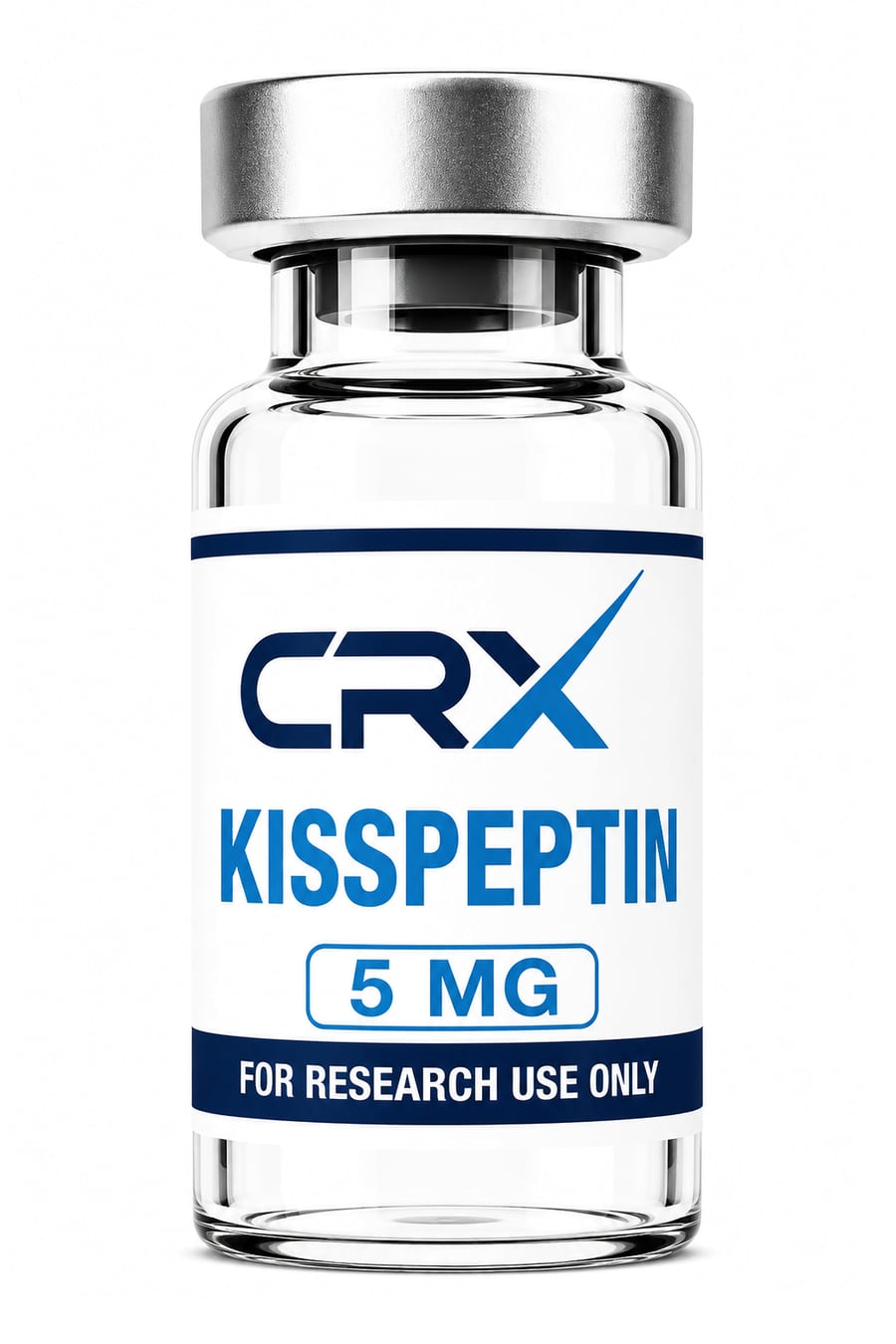
Kisspeptin
- Libido & sexual health
- Focus & brain health
- Fat loss & metabolism
Studied for libido, fertility and getting the reproductive axis to fire on its own — LH reached 10.8 U/L on infusion against 4.2 U/L on saline.
Read the published research →What Kisspeptin does
Kisspeptin acts a step further upstream than most hormone compounds: it works on the GnRH neurons in the brain that switch the reproductive axis on, so LH, FSH and testosterone rise because the body released them rather than because they were supplied. A 90-minute infusion in healthy men raised mean LH to 10.8 U/L against 4.2 U/L on saline and testosterone to 24.9 against 21.7 nmol/L; head to head, GnRH itself remained the more potent trigger, at roughly twice the LH exposure of kisspeptin-54, and the two kisspeptin fragments behaved much the same as each other. Its most developed clinical use is fertility: in 60 women at high risk of ovarian hyperstimulation undergoing IVF, a single injection matured eggs in 95%, and 45% of the 51 embryo transfers ended in a live birth. In hypoactive sexual desire disorder it shifted brain processing of sexual cues against placebo, with penile tumescence up to 56% higher than placebo in men. Repeated exposure is where the limits show: dosing over two weeks blunted the LH rise from 24.0 to 2.5 IU/L, mild ovarian hyperstimulation occurred in 3 of 60 IVF patients early and 1 of 60 late with no moderate or severe cases, and sustained high exposure in male rats caused testicular degeneration by overdriving the same central axis.
- Testosterone and LH from the body's own axis
- Libido and sexual desire
- Fertility support and egg maturation
- Restarting a suppressed hormone axis
- Arousal at the brain level rather than blood flow
- Insulin response to a glucose load
Common areas of interest, not measured results. The findings below are the published data.
In a phase 2 open-label trial in 60 women at high risk of ovarian hyperstimulation syndrome undergoing IVF, randomised between kisspeptin-54 dose arms with no hCG or placebo comparator, a single injection matured oocytes in 95% of women; across 51 embryo transfers the biochemical, clinical and live-birth pregnancy rates were 63%, 53% and 45%, rising to 85%, 77% and 62% in the 9.6 nmol/kg arm.14
In the first-in-human, uncontrolled study of kisspeptin-54 as an oocyte-maturation trigger, 53 subfertile women undergoing IVF each received a single subcutaneous injection across four dose arms from 1.6 to 12.8 nmol/kg, with randomisation only between dose cohorts and no placebo or active comparator; eggs were fertilised and embryos transferred in 92% (49/53), biochemical pregnancy occurred in 40% (21/53) and clinical pregnancy in 23% (12/53), and mature eggs per patient generally increased with dose.5
In 8 healthy women with regular menstrual cycles given a 0.4 nmol/kg subcutaneous bolus of kisspeptin-54 or saline in random order in each cycle phase, LH rose in every phase but the response depended on cycle stage: the mean increase over baseline was 20.64 +/- 2.91 IU/L preovulatory versus 0.12 +/- 0.17 IU/L follicular (P < 0.001) and 2.17 +/- 0.79 IU/L luteal (P < 0.01 versus follicular).15
For laboratory research use only. Not a drug, food, or cosmetic. Not for human or veterinary use, ingestion, or any form of consumption. Sold exclusively to qualified researchers.