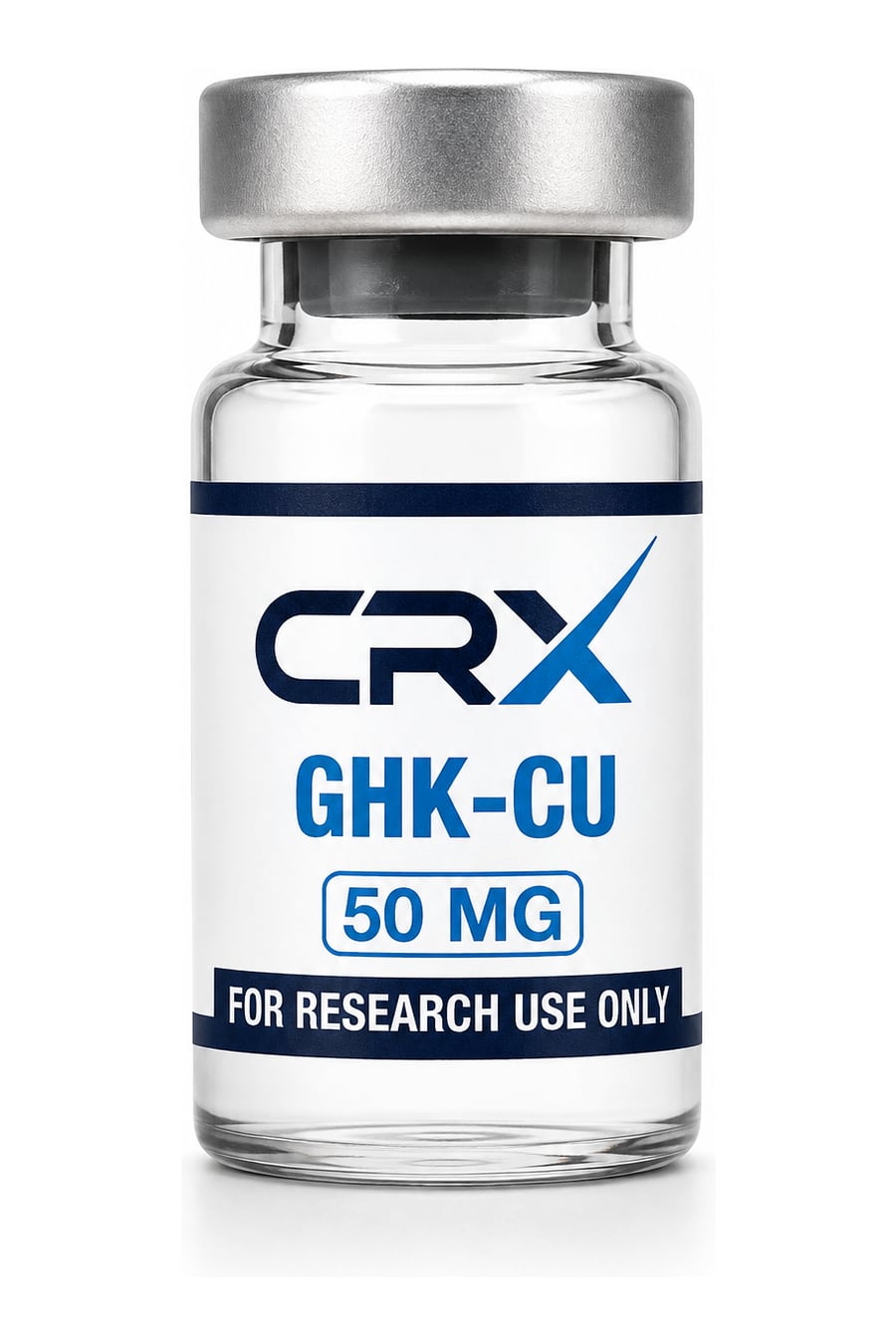
GHK-Cu
- Skin & hair
- Recovery & repair
- Energy & mitochondria
- Longevity & anti-ageing
The copper skin peptide — applied topically, it closed a median 98.5% of diabetic ulcer area against 60.8% under vehicle.
Read the published research →View COAs1 report
| Tested sample | Task number | Analysis date | Measured results | Report |
|---|---|---|---|---|
| 100 mg | 171246 | Jun 23, 2026 | GHK-Cu total: 91.33 mg · GHK content: 74.80 mg · Copper content: 16.53 mg · Purity: 99.729% |
What GHK-Cu does
GHK is a three-amino-acid fragment first found in human plasma and also sitting inside type I collagen; bound to copper it is the ingredient cosmetic chemistry calls copper tripeptide-1, and it is used on skin. On diabetic neuropathic ulcers the topical gel reached 98.5% median area closure against 60.8% for vehicle, with infection in 7% of treated ulcers versus 34% of vehicle-treated ones. It does not win everywhere: on venous stasis ulcers a copper tripeptide cream was no different from inert vehicle and silver sulfadiazine beat both, and after CO₂ laser resurfacing it matched standard care on erythema, wrinkles and overall skin quality at 12 weeks, though patients said they preferred it. The collagen story behind the cosmetic claims is cell and animal work — collagen synthesis in fibroblast culture, MMP-2 raised alongside its own inhibitors TIMP-1 and TIMP-2, keratinocyte proliferation and integrin expression up in reconstructed skin, more collagen and glycosaminoglycan in rat wound chambers. Who deserves the credit is genuinely unsettled: in the MMP-2 experiment copper alone reproduced the effect and the copper-free tripeptide did not, though GHK-Cu itself did not trigger the skin-irritation biomarkers that copper chloride and copper acetate raised.
- Fine lines, firmness and skin texture
- Collagen support in aging skin
- Post-procedure and wound recovery
- Hair thickness and scalp condition
- The look of scars and uneven tone
Common areas of interest, not measured results. The findings below are the published data.
In patients randomised after circumoral CO₂ laser resurfacing, investigators reported no statistically significant difference between copper tripeptide products and standard care for resolution of erythema, wrinkle improvement or overall skin quality at 12 weeks, although patient-reported satisfaction was higher in the copper tripeptide group.12
In a multicentre randomised evaluator-blinded placebo-controlled trial of topical GHK-Cu gel on diabetic neuropathic ulcers alongside debridement and offloading, investigators reported 98.5% median area closure versus 60.8% for vehicle, and infection in 7% versus 34% of vehicle-treated ulcers.14
In a prospective randomised evaluator-blinded trial in venous stasis ulcers, a 0.4% tripeptide copper complex cream did not differ from inert vehicle in ulcer size reduction, while 1% silver sulfadiazine was statistically superior to both.15
For laboratory research use only. Not a drug, food, or cosmetic. Not for human or veterinary use, ingestion, or any form of consumption. Sold exclusively to qualified researchers.