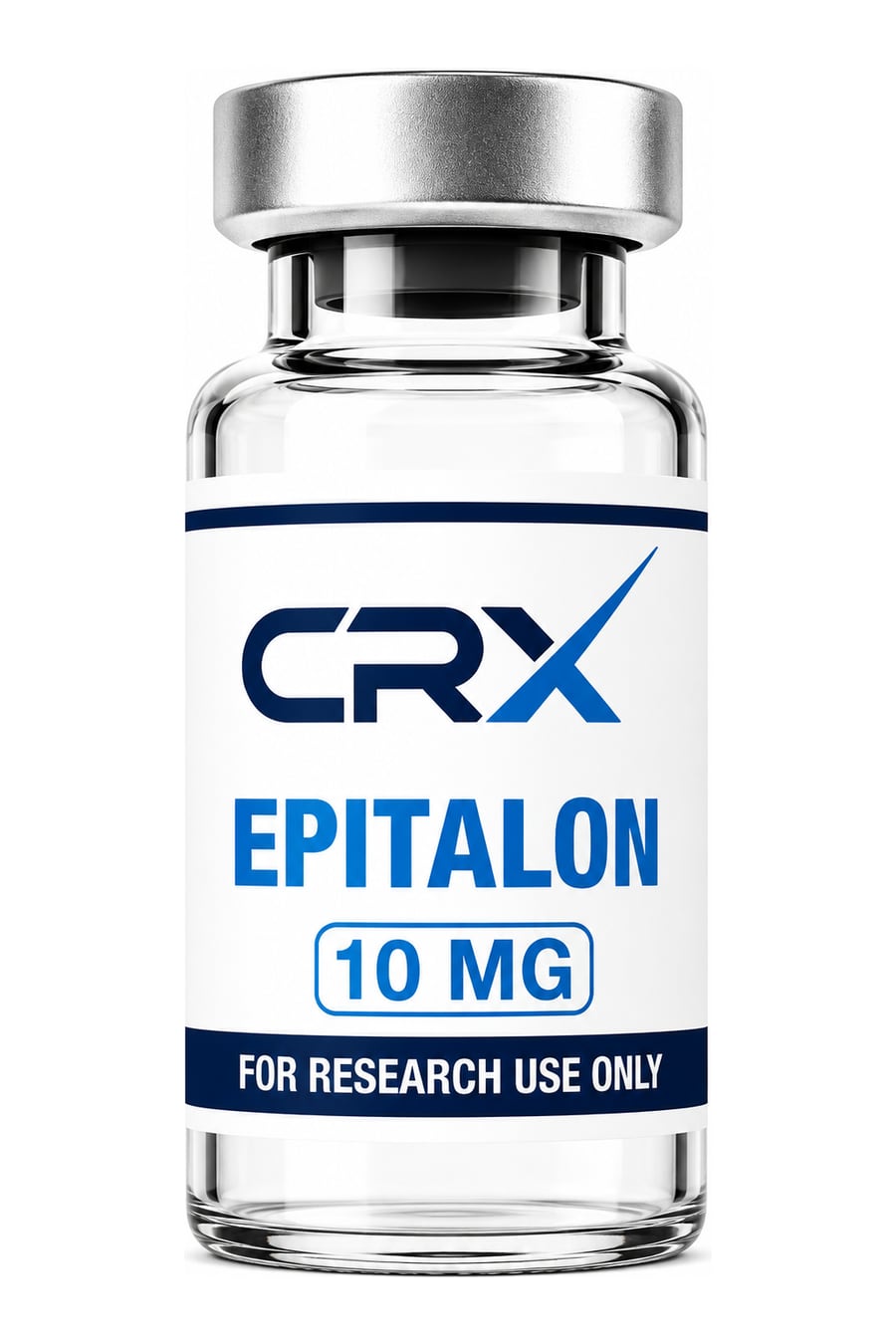
Epitalon
- Longevity & anti-ageing
- Sleep
- Recovery & repair
The telomere peptide — studied for cellular aging, telomerase activity, and how many more times a cell can keep dividing.
Read the published research →What Epitalon does
Epitalon is a four-amino-acid peptide built from the composition of a pineal gland extract, and what it does best is switch on transcription of hTERT, the catalytic subunit of telomerase. Cells that had exhausted their capacity to divide re-lengthened their telomeres and went on through ten further divisions while untreated controls stayed stopped, and in normal epithelial cells and fibroblasts the lengthening was dose-dependent, tracking raised hTERT mRNA and telomerase activity. Over a full lifespan study, mean life span was unchanged against saline, but the last 10% of survivors lived 13.3% longer, maximum life span rose 12.3%, bone-marrow chromosome aberrations fell 17.1% and leukaemia incidence dropped six-fold. All of that is cell culture and mice, and the melatonin claim attached to the peptide is contested even there — raised in cultured pineal cells, absent in intact glands, in a study co-authored by the peptide's own originators. One result carries forward as a caution: the same experiment that lengthened telomeres in normal cells lengthened them in two breast cancer lines too.
- Telomere length and cellular aging
- Sleep and circadian rhythm in later life
- Antioxidant and cell-stress support
- Skin and eye tissue aging
- Egg and reproductive cell quality
- Long-horizon longevity protocols
Common areas of interest, not measured results. The findings below are the published data.
In a clinical report from the peptide's originating institute, Epitalon therapy in patients with degenerative retinal lesions was said to produce a positive clinical effect in 90% of cases; the paper reports no sample size, comparator arm or outcome definition for the human part, so the figure cannot be interpreted, and the controlled data in the same paper come from Campbell rats, in which the peptide preserved retinal morphological structure and intensified the retina's bioelectric and functional activity.5
In female outbred Swiss-derived SHR mice treated from age 3 months until natural death, 54 per group, Epitalon left mean life span, food consumption and body weight unchanged versus saline, but raised the life span of the last 10% of survivors by 13.3% (P<0.01) and maximum life span by 12.3%, cut bone-marrow chromosome aberrations by 17.1% (P<0.05) and lowered leukaemia incidence 6.0-fold; total spontaneous tumour incidence was unchanged.17
In female FVB/N HER-2/neu transgenic mice treated from age 2 months, the Epitalon arm showed a reduced cumulative number and maximum size of spontaneous mammary tumours versus saline (P<0.05), smaller but not fewer lung metastases, and a 3.7-fold reduction in HER-2/neu mRNA in the tumours; the comparator dipeptide Vilon (Lys-Glu), run in the same experiment, instead increased mammary cancer incidence and shortened tumour latency.18
For laboratory research use only. Not a drug, food, or cosmetic. Not for human or veterinary use, ingestion, or any form of consumption. Sold exclusively to qualified researchers.