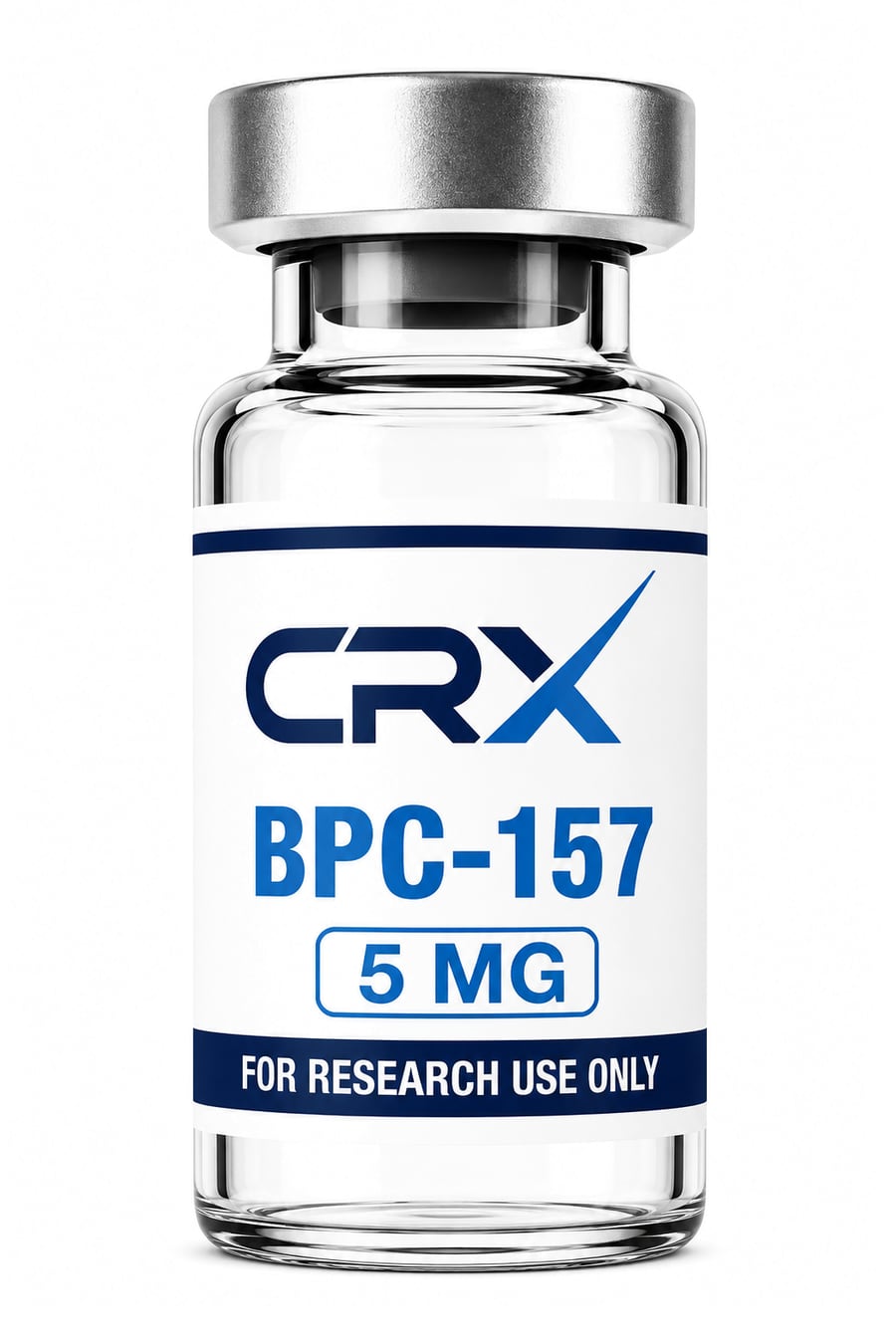
BPC-157
- Recovery & repair
- Inflammation & immunity
- Growth hormone
- Focus & brain health
The repair peptide — studied for tendon and ligament healing, gut lining, and getting blood flow into damaged tissue.
Read the published research →View COAs1 report
| Tested sample | Task number | Analysis date | Measured results | Report |
|---|---|---|---|---|
| 10 mg | 171256 | Jun 22, 2026 | BPC-157: 13.27 mg · Purity: 99.765% |
What BPC-157 does
BPC-157 is a 15-residue fragment of a protein found in gastric juice, and the repair results behind its reputation are real and specific. Cut Achilles tendons recovered higher load-to-failure and better function than saline controls through day 14; cut knee ligaments improved on function, mechanics and histology over controls across 90 days; an 8 mm gap in the radius reached healing comparable to an autologous graft in six weeks, where no saline control healed at all. The mechanism that has replicated outside the originating laboratory is blood-vessel growth — cultured human endothelial cells increase and internalise VEGFR2, and ischaemic limbs recover blood flow faster. Most of that work is in rats and rabbits, and one oddity runs underneath it: the intact peptide's measured half-life is under 30 minutes, which is hard to square with effects reported over days. Worth knowing if you compete: material sold under this name is prohibited in sanctioned sport.
- Tendon and ligament recovery after injury
- Joint pain and post-surgical healing
- Gut lining and digestive comfort
- Protection against anti-inflammatory stomach damage
- Blood flow into healing tissue
- Muscle and soft-tissue strains
Common areas of interest, not measured results. The findings below are the published data.
The only human musculoskeletal report is a retrospective single-clinic chart review with telephone follow-up, not a trial: of 16 contactable patients given intra-articular BPC-157 for mixed causes of knee pain, 11 of the 12 who received it alone self-reported improvement. There was no control group, no blinding, no validated outcome instrument and no imaging.13
In an uncontrolled, unblinded single-arm pilot, 12 women with interstitial cystitis unresponsive to pentosan polysulfate received peri-lesional injections during cystoscopy and all 12 scored 5/5 on the Global Response Assessment. With no control arm, no blinding and no objective endpoint, this cannot separate a treatment effect from procedural and placebo effects.15
In rats whose Achilles tendon was surgically transected, animals given BPC-157 showed higher load-to-failure and Young's modulus, higher Achilles functional index scores and smaller macroscopic tendon defects than saline-treated controls through day 14.9
For laboratory research use only. Not a drug, food, or cosmetic. Not for human or veterinary use, ingestion, or any form of consumption. Sold exclusively to qualified researchers.