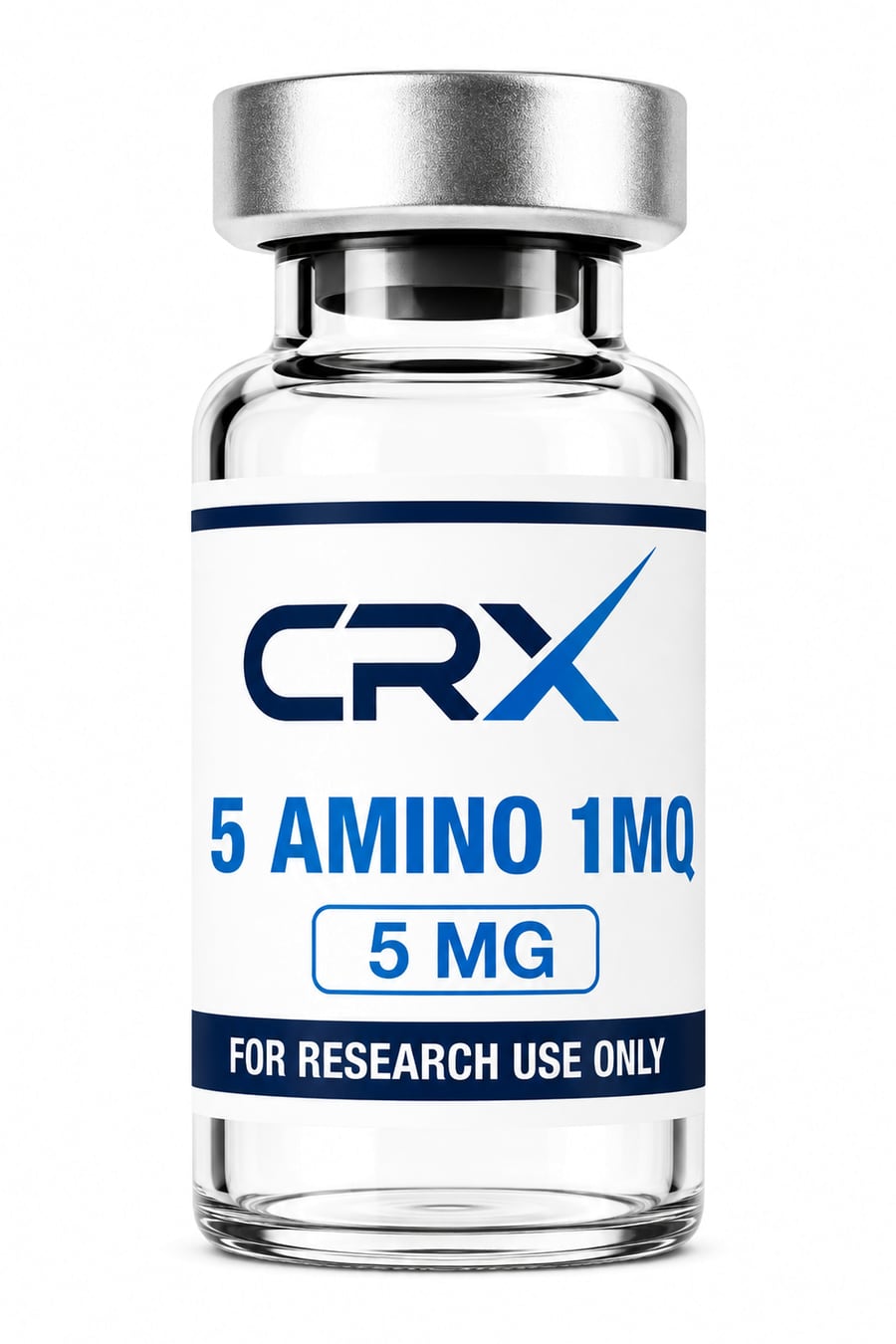
5-Amino-1MQ
- Fat loss & metabolism
- Longevity & anti-ageing
- Recovery & repair
A small-molecule enzyme inhibitor studied for its effects on body fat and muscle strength.
Read the published research →What 5-Amino-1MQ does
5-Amino-1MQ blocks nicotinamide N-methyltransferase, an enzyme that consumes both a cell's methyl donor and a precursor that would otherwise be recycled into NAD+; blocking it raises NAD+ and SAM inside the cell and cuts lipid accumulation in fat cells. In diet-induced obesity it held body weight and fat gain well below vehicle controls without reducing food intake, and improved glucose handling, liver weight and liver fat against those same controls. In aged animals it raised grip strength about 40% over sedentary controls and, after a chemical muscle injury, gave nearly twice the myofiber cross-sectional area and about 70% more peak torque than saline controls. Not everything moved with it: on a plantarflexor fatigue task treated animals did significantly less cumulative work than saline controls, and a broad off-target screen found the compound also inhibits monoamine oxidase-A, which the authors suggest may account for part of the glucose effect. All of this is mouse and cell-culture work, and it was delivered by injection: measured oral bioavailability in mice was 3.5%.
- body composition and fat-loss research
- NAD+ and cellular energy metabolism
- age-related muscle strength and sarcopenia models
- skeletal muscle regeneration after injury
- metabolic and fatty liver research
- combination with dietary change in preclinical obesity models
Common areas of interest, not measured results. The findings below are the published data.
In diet-induced obese mice given subcutaneous injections for 11 days, 5-amino-1MQ-treated animals lost 2.0 g of body weight (about 5.1% from baseline) while saline controls gained 0.6 g (about 1.4%). Epididymal white adipose mass was roughly 35% lower, adipocyte size more than 30% smaller, and plasma total cholesterol about 30% lower than in saline controls.2
In diet-induced obese mice injected subcutaneously once daily for about 30 days, the high-dose 5A1MQ arm gained 0.9 g of body weight against 5.4 g in vehicle controls, and 1.3 g of fat mass against 4.7 g. The low-dose arm gained 5.2 g and was no different from vehicle. Lean mass showed no treatment effect in any arm.4
In the same diet-induced obese mice, fed-state plasma insulin rose 112% from baseline in vehicle controls and 46% in the low-dose arm, but fell 9% in the high-dose arm. On a day-21 oral glucose tolerance test, high-dose animals had lower glucose at 15 and 30 minutes and lower insulin at 15 minutes than both comparators. The authors note off-target MAO-A activity may explain part of that glucose effect.4
For laboratory research use only. Not a drug, food, or cosmetic. Not for human or veterinary use, ingestion, or any form of consumption. Sold exclusively to qualified researchers.